Phoenix Fence, Wall and Gate Rules
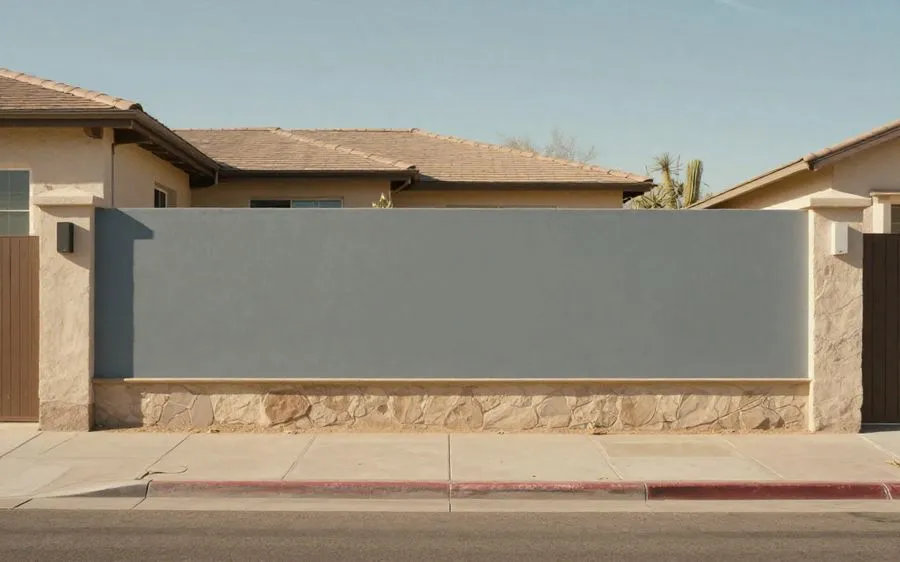
Phoenix is stricter than the internet repeats in two places that catch homeowners: the front-yard height and the permit trigger. I would check both before I sketched a wall, bought block, or accepted a bid. The figures below follow the city summary and identify the code section behind each one.
The number everyone gets wrong
In a Phoenix front-yard setback, the limit is 40 inches, not 3 feet. The 3-foot figure applies in a Historic Preservation overlay. That extra 4 inches is not a rounding error when the wall is visible from the street.
The second bad rule of thumb is that a fence under 6 or 7 feet never needs a permit. In Phoenix, a fence or wall over 3 feet needs one under Phoenix PBCC 105.2.2 (TRT/DOC/00181). Per ZO 703.A, as summarized by the city in its September 16, 2013 revision, verify every height against the current ordinance before building.
Are you actually in Phoenix?
An address with a Phoenix mailing address is not automatically inside the City of Phoenix. Some valley parcels are under Maricopa County jurisdiction, and county rules can differ. Use the assessor parcel lookup to identify the governing jurisdiction before relying on any number on this page.
The ground rules
In this market, start with the wall and fence rules, then get HOA approval in writing before filing the city permit. An HOA approval is not a city permit, and a permit does not replace HOA approval.
Call Arizona 811 at least two full working days before digging. If your parcel is outside the city, confirm the county’s engineering requirements too, including whether its rules call for an engineer’s seal. For the application sequence, see the fence permit process.
Heights by yard
Read the location before the number. A 6-foot side wall can be allowed while the same wall becomes a problem at a street corner or inside a front setback. Phoenix measures height from the higher adjacent finished grade, averaged perpendicular to the wall within 50 feet. That measurement detail matters when one lot was graded above the next one.
| Where | Limit | Source section | Check date |
|---|---|---|---|
| Front-yard setback | 40 in; 3 ft in a Historic Preservation overlay | Phoenix Zoning Ordinance 703.A | 2026-07-29 |
| Side and rear yard | Up to 6 ft | Phoenix Zoning Ordinance 703.A | 2026-07-29 |
| Side or rear yard abutting an arterial street | Up to 8 ft with a use permit | Phoenix Zoning Ordinance 703.A | 2026-07-29 |
| Visibility triangle | No obstruction over 3 ft | Phoenix City Code 31-13 | 2026-07-29 |
| Fence or wall permit trigger | Over 3 ft | Phoenix PBCC 105.2.2 | 2026-07-29 |
| Engineering trigger | Over 7 ft requires structural calculations | Phoenix PBCC 105.2.2 | 2026-07-29 |
Per ZO 703.A, a side or rear yard that abuts an arterial street can go to 8 feet with a use permit. That does not turn every rear wall into an 8-foot wall. The arterial condition and the permit both matter.
There is a separate rule for subdivisions platted after May 2, 2008: an 8-foot solid wall is required along a common line with non-residential zoning. Do not confuse that required screening wall with the arterial-street option. For a city-to-city comparison, use wall and fence rules by city.
Permit, and who issues it
Planning & Development’s Development Services Division issues the permit. A wall or fence over 3 feet needs one, and a structure over 7 feet needs structural calculations under Phoenix PBCC 105.2.2.
The fee basis is valuation-based under City Code Appendix A.2. I would not turn that into a dollar estimate: no confirmed fee figure belongs here. Ask Development Services how the current valuation-based fee applies to the work shown on your plans.
The corner and the driveway
At a street intersection or driveway, Phoenix City Code 31-13 limits obstructions in the visibility triangle to 3 feet. On a corner lot, that can cut down the portion of an otherwise permitted 6-foot side wall nearest the intersection. The wall is not judged only by its yard label.
Set the wall line after you identify the triangle, not after block is delivered. Wall height and setback rules covers the geometry in more detail.
What you may not build
Where a fence is visible from a public street or adjacent residential area, Phoenix ZO 507 Tab A prohibits chain link with slats, sheeting, non-decorative corrugated metal, and razor, concertina, or barbed wire. A material can be available from a supplier and still be disallowed in that visible location.
That visibility condition deserves a plan check before you choose a screening treatment. Do not assume a material is acceptable just because a neighboring property has something similar.
Before you build in Phoenix
Use this checklist before you draw the final wall line:
- Confirm that the parcel is inside the City of Phoenix.
- Check the height rule for the specific yard.
- Get HOA approval in writing.
- File with Planning & Development when the wall or fence is over 3 feet.
- Call Arizona 811 two full working days before digging.
- Verify the contractor’s ROC classification.
FAQ
Do I need a permit for a fence in Phoenix?
Yes, if the fence or wall is over 3 feet. Phoenix PBCC 105.2.2 sets that trigger, so the commonly repeated national under-6-foot rule does not apply here.
How tall can my front fence be?
The front-yard setback limit is 40 inches. In a Historic Preservation overlay, the limit is 3 feet, per ZO 703.A as summarized by the city; verify the current ordinance for your parcel.
Is chain link allowed?
Chain link with slats is not allowed where it is visible from the street or neighboring residential property. Phoenix ZO 507 Tab A also names sheeting, non-decorative corrugated metal, and razor, concertina, or barbed wire in that visible setting.
My lot backs an arterial. Can I go to 8 feet?
Yes, a side or rear yard abutting an arterial street may go to 8 feet with a use permit. The rule is in ZO 703.A, and it is not an automatic height increase for every rear yard.
Am I sure I am in Phoenix?
No, not until you check the parcel lookup. A Phoenix mailing address can be in unincorporated Maricopa County, where a different rule may govern the work.
Check your parcel, then check your yard’s limit before you draw anything. Compare Mesa’s different permit approach and Scottsdale’s approval rules if your address is near a jurisdiction line.
Sources
- Phoenix Zoning Ordinance 703.A - height limits and measurement convention.
- Phoenix City Code 31-13 - visibility triangle.
- Phoenix PBCC 105.2.2 (TRT/DOC/00181) - permit and structural-calculation triggers.
- Phoenix ZO 507 Tab A - prohibited visible materials.
Last reviewed 2026-07-29. Each figure on this page is to be re-read against the city’s current code at least annually.
This is a sourced summary, not certified advice. The city’s operative summary cited here is dated September 16, 2013; verify each figure against the current Phoenix ordinance and confirm how it applies to your parcel before construction.
Reviewed by Alma Reyes, ICC-certified residential building inspector.
Read next in cities
Chandler Fence, Wall and Gate Rules
How tall a fence can be in Chandler, why zoning clearance applies at any height, the retaining triggers, and the local pool barrier that is taller than the state's.
Gilbert Fence, Wall and Gate Rules
How tall a fence can be on a property line in Gilbert, where the three-foot permit line falls, and which materials the town's code will not accept.
Glendale Fence, Wall and Gate Rules
How tall a fence can be in Glendale, when the Section 7.200 eight-foot exception applies, and what the city still has to confirm about permits.
Want a licensed contractor to call you back?
Leave a number and we pass it to a licensed Arizona contractor. We are not one, we do not bid on the work, and we do not sell your number on.
Request a callback
Send your number to [email protected] with the best time to call and one line about the project. It reaches a person, not an autoresponder, and the page you were reading travels with it so we know what you were pricing.
Advertiser disclosure: this page is free to read because a contractor may pay us for a lead that comes from it. That arrangement never changes what a page says. We publish no contractor names, no rankings and no reviews, and we say plainly when a project is not worth doing.