Do You Need a Permit for a Wall or Fence in Metro Phoenix? The City Process, Fee and Blue Stake Call
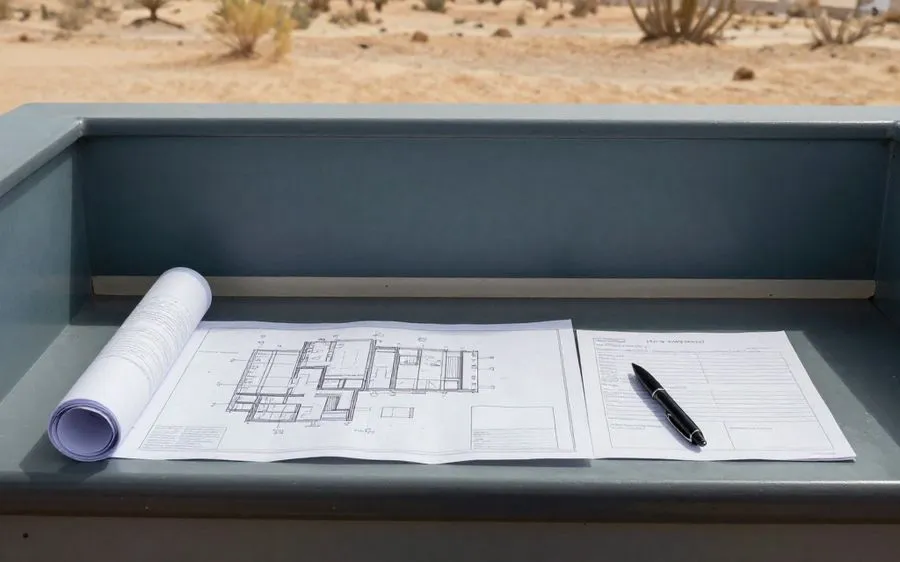
Nine jurisdictions sit inside the metro Phoenix conversation, and they do not give one answer to “Do I need a permit?” I pulled permits in four cities in one month and kept the thresholds on a card in my truck because they would not stay in my head. A six-foot rule borrowed from a national model code can put a Phoenix homeowner on the wrong side of the counter.
Permit triggers, fees, and lot rules change by city and property. Confirm the current rule with your city’s planning or development department before building. This page is an information tool, not your permit office or contractor.
Two approvals, not one
A city permit is the safety and land-use gate. An HOA or other community association approval is the design and covenant gate. One does not replace the other, which is why paying a city filing fee before getting the association’s written approval can leave you with a permitted plan that the neighborhood will not approve.
Keep those files separate. For the architectural side, start with the second approval most of the valley also needs. This page stays on the city process: the height trigger, application, locate call, and license line that belong in a quote.
Does your city require a permit - and above what height?
The first job is identifying the jurisdiction, not measuring the wall. A Phoenix mailing address is not enough if the parcel is in an unincorporated pocket. City limits change the answer, and county drainage review can enter before a building permit does.
“Nothing under six feet needs a permit” is a national model-code line, not a metro Phoenix rule. Phoenix, Scottsdale, and Gilbert each have a 3-foot threshold in the material reviewed for this guide. Queen Creek requires a permit for all fence and wall construction. Tempe is the exception that needs an honest blank: its over-7-foot permit point is confirmed, but its exemption line was not cleanly captured, so call the city rather than borrowing a number from a neighboring row.
| Jurisdiction | Permit required above | Engineering required above | Retaining-wall trigger | Other approval that applies regardless | Code reference | Source date |
|---|---|---|---|---|---|---|
| Phoenix | 3 ft | 7 ft for structural calculations | Over 3 ft unless surcharged | Check city zoning for the parcel | PBCC 105.2.2, TRT/DOC/00181 | Current source reviewed for this guide |
| Scottsdale | 3 ft | Check city requirements for the design | Check with city | Courtesy site-plan approval for any wall | City of Scottsdale, Walls & Fences | May 21, 2026 |
| Gilbert | 3 ft | Check city requirements for the design | Under 4 ft without surcharge is exempt | Check city requirements | Gilbert LDC / Building Department | Current source reviewed for this guide |
| Mesa | More than 6 ft on single-residence zoning | Check city requirements for the design | Check with city | Desert Uplands, Historic Preservation overlay, and public easement exceptions apply | Mesa City Code Title 11 Ch. 14 | Current source reviewed for this guide |
| Chandler | 7 ft | Check city requirements for the design | Over 4 ft, or a fence atop a retaining wall | Zoning clearance at any height | Chandler Homeowner Building Permit Manual | Current source reviewed for this guide |
| Peoria | 7 ft | Over 8 ft receives City Engineer review | Check city requirements | Engineering permit for right-of-way work | Peoria City Code Sec. 21-312 | Current source reviewed for this guide |
| Queen Creek | All fence and wall construction | When the detail requires it | Check town requirements | Standard detail or engineered drawing | Town of Queen Creek fencing requirements | Current source reviewed for this guide |
| Tempe | Not confirmed - call the city | Over 7 ft is confirmed | Not confirmed - call the city | Check with the development department | ZDC 4-702 / 4-706 | Current source reviewed for this guide |
| Unincorporated Maricopa County | Check zoning and building permit rule | See county directive | Check county requirements | Drainage Clearance over 1 ft; Floodplain Use Permit in a flood hazard area | DD-5012-01; MCZO 1504.5.2 | May 4, 2026 |
Read a table row as a starting point, not as permission to build. Mesa’s exemption, for example, is tied to single-residence zoning and has named exceptions. Scottsdale can require a courtesy site-plan approval even where the wall does not cross its building-permit height. The code citation is there so you can ask the counter a useful question instead of asking for a generic fence answer.
Permit checker
Choose a place, height, and wall type for a quick screening result. It does not replace a parcel review, and it deliberately returns a call-the-city result for Tempe.
Select your city and enter the planned height.
Source note: city documents listed in the jurisdiction table; check date July 29, 2026. Any excavation still requires an Arizona 811 locate request.
Action algorithm - from idea to permit
- Confirm whether the parcel is inside a city or unincorporated county.
- Find the applicable height trigger and the city document behind it.
- Check whether height, wall thickness, retaining work, or surcharge crosses the engineer-seal point.
- Get community approval in writing before paying the filing fee.
- Assemble the site plan, elevation, and any required seal, then file with the issuing body.
- Submit an Arizona 811 ticket at least two full working days before excavation.
- Verify the contractor’s license class with the Arizona Registrar of Contractors.
- Book the inspections required by the permit instead of covering the work first.
When the wall needs an engineer, not just a permit
The county’s current DD-5012-01 revision, dated May 4, 2026, points to stamped engineering for CMU that is 6 inches or thicker and over 7 feet. It also applies to retaining walls over 4 feet measured from bottom of footing to top, or to a retaining wall carrying a surcharge. A fence line can cross this boundary without looking dramatic from the patio.
Do not use an old county PDF as a cheaper rule. Its 6-foot and 9-foot figures are superseded by the current revision. I have watched a footing decision turn into a monsoon problem after a bad call of my own, and that is why I do not treat a wall’s visible height as the whole design question.
The permit fee is rarely the part that changes the job once an engineer enters. The sealed plan, design responsibility, and contractor scope are the cost exposure. Keep the engineer’s requirement in its own quote line so nobody can bury it under a vague “permit allowance.”
For placement, setbacks, and the sight-triangle rules that sit beside these triggers, see how high the wall can be where you want to put it. This page does not replace that site-specific review.
What the permit costs
There is no confirmed metro Phoenix dollar figure to print here. That is not a gap I will fill with a number from a contractor blog. Fee schedules change, valuations differ, and a plan-review line can matter more than a headline fee.
Phoenix bases the permit fee on valuation under City Code Appendix A.2. Scottsdale’s structure includes plan review by the hour plus a per-linear-foot component. Other cities use their own schedules. Pull the current schedule for your jurisdiction and compare it with the permit line on the bid before you sign.
As a general planning expectation, the filing fee is often in the tens to low hundreds of dollars, but confirm that against the current city schedule rather than treating it as a quote. The engineered plan and a properly licensed scope above a trigger are usually the meaningful money. For context, compare what the permit fee looks like next to the rest of the bill, not a made-up permit total.
Call Blue Stake before you dig
Arizona 811, formerly Blue Stake, is free. Under A.R.S. 40-360.21 through 40-360.32, the excavation notice is due at least two full working days before digging. A footing trench counts. So does a post hole.
Open the locate request before the crew, auger, or rented trencher is on the driveway. Once marks are placed, hand-dig near them. Paint on bare desert soil can look like a minor inconvenience until an unmarked assumption turns into a damaged line.
The exposure is not a tidy published number for this article. Striking a facility can shift repair liability to the excavator, with penalties that can reach into the thousands as well as repair costs. The free notice is the cheaper piece of paperwork in this process.
Who is allowed to do the work
For masonry scope, look for CR-31. For ornamental metal work, look for CR-24. CR-58 is HVAC, not masonry, despite the error that keeps appearing in contractor content. Verify both the number and the active class with the Arizona Registrar of Contractors before the first payment, because a company name alone does not tell you what work its license covers.
That verification gives a homeowner a regulator and complaint route if the work goes bad. The materials reviewed for this guide describe a generally two-year complaint window for new homes and a Residential Contractors’ Recovery Fund with limits of up to $30,000 per structure and $200,000 per license. Confirm current eligibility and limits with the Registrar and the applicable statutes before counting on either remedy.
| Class | What it covers | When you need it |
|---|---|---|
| CR-31 | Masonry work | A contractor performing the block-wall masonry scope |
| CR-24 | Ornamental metals | A contractor performing ornamental metal fence or gate work |
| CR-58 | HVAC, not masonry | Never accept it as the class for block-wall masonry |
Quote red flags
- “No permit needed” with no city rule or code section named.
- A license class that does not match the scope on the proposal.
- No license number at all.
- A permit line with no explanation of who files and who pays it.
- Pressure to dig before the locate ticket clears.
I would rather lose an afternoon verifying a class than spend months arguing about who was supposed to pull a permit. The Registrar check is not a character reference. It is a basic scope check.
What you actually submit
Start with a scaled site plan. Put a north arrow on it, show existing structures, and mark the proposed wall’s location and length. The elevation should show construction detail, not just a line labeled “6 feet.” If the height or wall condition triggers engineering, add the sealed plans. Where the city requires zoning clearance at any height, include that before treating the submittal as complete.
City portals exist in some jurisdictions, but a portal is only the delivery route. It does not cure a missing site plan or a vague elevation. State in the contract who pulls the permit, whose name is on it, and who responds to plan-review comments.
Submittal checklist
- Scaled site plan.
- North arrow.
- Existing structures shown on the plan.
- Proposed wall location and length.
- Elevation with construction detail.
- Engineer seal where the trigger applies.
- Zoning clearance where the city requires it.
- Written statement of who pulls the permit.
Keep a copy of the submitted set. When a contractor says the city changed the request, you should be able to see what was actually filed.
What happens if you skip it
A city can issue a stop-work order, require a retroactive permit with a penalty, and require changes or removal if the built wall cannot be approved. Insurance and resale questions can follow when unpermitted work appears in a claim, disclosure, or inspection.
“No permit” never means “no rules.” Heights, setbacks, and sight triangles still apply where the permit threshold is not crossed, under documents such as Phoenix Zoning Ordinance 703.A and MCZO 1111.5. Do not ignore a stop-work order while hoping the project disappears from view.
Common questions about wall and fence permits in metro Phoenix
Is it true that nothing under six feet needs a permit?
No. That is a national model-code line, not a reliable metro Phoenix rule. Phoenix, Scottsdale, and Gilbert use 3-foot triggers in the city materials reviewed here, while Queen Creek requires a permit for all fence and wall construction.
How much is a fence permit?
The fee comes from each city’s schedule, and no confirmed metro dollar figure is published here. Check your jurisdiction’s current schedule because Phoenix uses valuation and Scottsdale includes hourly plan review plus a per-linear-foot component.
Do I need to call 811 for a fence post hole?
Yes. A post hole is excavation, so file an Arizona 811 request at least two full working days before digging and hand-dig near the marks. The notice is free.
What license should my block wall contractor hold?
CR-31 is the masonry class, while CR-24 covers ornamental metals. CR-58 is HVAC, so it is the wrong answer for a block-wall masonry contract.
Do I need a permit to replace an existing wall?
Often a like-for-like repair below a local threshold can be exempt, but the result varies by city and scope. Confirm the particular repair with the city before treating an existing wall as a permit exemption.
I already built it without a permit. What now?
Ask the city about a retroactive permit and expect a penalty or required modification. Do not ignore a stop-work order, because the wall may still need to be changed or removed.
Find your jurisdiction in the table, run your wall through the checker, and get community approval in writing before you pay a filing fee. This site performs no construction work or permit filing.
Sources
- Phoenix PBCC 105.2.2, TRT/DOC/00181: Phoenix permit and structural-calculation triggers.
- Maricopa County DD-5012-01, revision May 4, 2026: engineer-seal trigger; the November 20, 2024 PDF figures are superseded.
- Chandler Homeowner Building Permit Manual: Chandler wall, retaining-wall, and zoning-clearance rules.
- Mesa City Code Title 11 Chapter 14, ordinances 4242, 4579, and 4807: Mesa exemption and exceptions.
- City of Scottsdale, Walls & Fences, updated May 21, 2026: Scottsdale permit and courtesy site-plan gate.
- Peoria City Code Sec. 21-312: Peoria height threshold and City Engineer review.
- A.R.S. 40-360.21 through 40-360.32 via azcc.gov: excavation-notice timing.
- Arizona Registrar of Contractors license classifications and A.R.S. Title 32 Chapter 10: CR-31, CR-24, recovery-fund, and complaint information.
Last reviewed 2026-07-29. Every trigger row is re-read against the city’s own document at review; fee schedules and adopted code editions expire fastest.
Confirm current triggers, fees, setbacks, and permit requirements with your city’s planning or development department before construction. A permit does not satisfy community-association approval, and association approval does not satisfy the city. Verify a contractor’s current class with the Arizona Registrar of Contractors. This site is not your city and does not perform the work.
Reviewed by Alma Reyes, ICC-certified residential building inspector
Read next in permits and approvals
What your HOA architectural committee can and cannot require for a wall or fence in Arizona, what to submit, and why its approval comes before the city permit.
How high a wall can be in the front, side and rear yard, what the corner-lot sight triangle cuts it to, and how a retaining wall is measured and triggered.
Want a licensed contractor to call you back?
Leave a number and we pass it to a licensed Arizona contractor. We are not one, we do not bid on the work, and we do not sell your number on.
Request a callback
Send your number to [email protected] with the best time to call and one line about the project. It reaches a person, not an autoresponder, and the page you were reading travels with it so we know what you were pricing.
Advertiser disclosure: this page is free to read because a contractor may pay us for a lead that comes from it. That arrangement never changes what a page says. We publish no contractor names, no rankings and no reviews, and we say plainly when a project is not worth doing.