Wall and Fence Comparisons in Metro Phoenix
Five head-to-head decisions, each settled on a twenty-year horizon rather than an install bid, plus the estimator that puts your own numbers behind the answer.
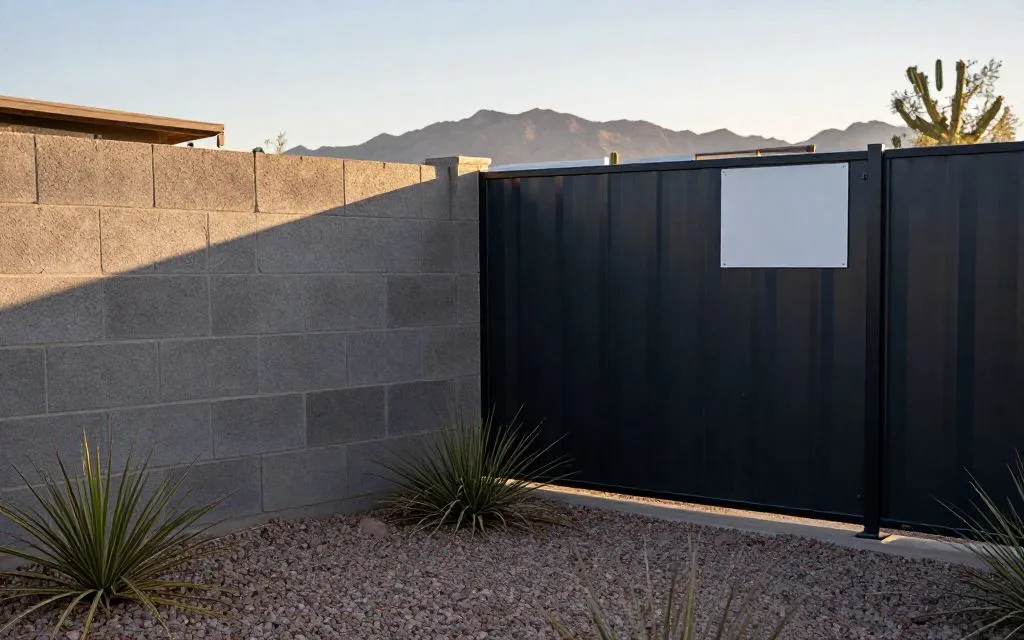
The install bid is the wrong number
Almost every barrier comparison you will find online ranks options by what they cost to put in.
Here that ranking is wrong often enough to be worth stating as a rule. In a climate running an ultraviolet index above 11 through the summer, with surface temperatures that swing hard between afternoon and dawn, the cheapest barrier to install is frequently the most expensive one to keep.
A fair comparison holds both options to the same service horizon, usually twenty to thirty years, and counts everything that happens inside it. Not just the install. Every re-stain, every repaint, every panel replacement, every full teardown and rebuild that falls within the window. (A teardown inside the window is not a hypothetical for wood out here, as the table below shows.)
Run that arithmetic on a wood fence at a two-to-three-year re-stain cycle against a masonry wall that mostly wants to be left alone, and the ranking you started with usually inverts somewhere around year eight.
That is the method the five pages below share. Each applies it to one fork; this page holds the reasoning behind it so the comparisons do not have to re-argue it every time, and the six steps at the foot of the page let you run it on a fork none of them covers.
The axes that actually decide it
A comparison collapses into an argument when nobody has agreed what is being optimized. Six axes separate any two barrier options, and this is the honest order to weigh them in.
Privacy against view. Solid and open are not two grades of the same product. One blocks sightlines and one preserves them, and a reader who has not decided which they want cannot be given a winner.
That is the most common category error in this market, and one of the five pages exists mainly to keep the two apart.
Upfront cost against lifecycle cost. Discussed above, and the reason four of these five pages carry a lifecycle table rather than a price.
Maintenance burden. Not the money, the obligation. A finish schedule that assumes you will re-stain on time is a different product from one that does not care whether you show up.
Behavior under this specific climate. Ultraviolet, heat cycling, monsoon microburst wind, and below the surface, caliche and expansive clay driving what the footing costs before anything is visible.
What the community permits. A covenant can remove an option entirely regardless of its merits, and many Valley communities do exactly that on street-facing elevations.
Code and permit triggers. Height thresholds and the engineering line sit above all of it, and they are set locally.
Price belongs last on that list, and this is not idealism. The first five axes can each eliminate an option outright, and there is no point pricing something you cannot build.
What the desert does to each material family
Two categories hold their structural properties under sustained high ultraviolet: reinforced concrete masonry, and ornamental metal, which the trade here sells as view fence and nearly everyone else calls wrought iron. Polymer and organic materials, meaning vinyl and wood, lose mechanical properties over years of the same exposure.
That split explains more of the table below than any single number in it.
The claims themselves need handling with tongs. Every figure below is a commercial or professional estimate presented as a range, and none of it is peer-reviewed:
| Option | Reported service life | What the cycle is | Reported installed cost |
|---|---|---|---|
| Block wall (CMU) | 30 to 50 years and beyond | Effectively no finish cycle on bare block | About $60 to $180 per linear foot |
| View fence (powder-coated steel) | 20 to 30 years, finish-dependent | Architectural-grade powder coat 10 to 15 years to first touch-up; lower grades 2 to 3 | About $55 to $120 per linear foot |
| Vinyl, desert-rated grade | 10 to 15 years; standard grade 5 to 7 | Replacement, not refinish | About $35 to $85 per linear foot |
| Wood | 5 to 10 years; 8 to 12 if genuinely maintained | Re-stain every 2 to 3 years | About $20 to $50 per linear foot |
Cost figures are 2025 to 2026 commercial estimates and vary widely with height, finish, site access and whether the footing hits caliche. The verified rate table is where the real numbers live.
One caveat travels with the first row and must never be separated from it: a block wall lasts decades if its footing and drainage are sound.
A wall that fails in this valley has almost always suffered a footing or drainage failure rather than a material one, and the repair page opens with diagnosis instead of patching for exactly that reason.
What the rules can take off the table before price does
Readers routinely arrive looking for the Arizona fence law. There isn't one, in the sense they mean. Arizona has no general state statute governing residential fence or wall height, material or setback.
State fence law reaches two places only: swimming-pool barriers under A.R.S. 36-1681, and livestock and open-range fencing under Title 3. Everything else is municipal ordinance plus the private covenants on your parcel.
That makes the covenant the first real gate.
Many Valley communities cap front-yard barriers around 3 to 4 feet to preserve sightlines, cap rear yards near 6 feet, restrict which materials may face the street, and require written architectural committee approval before anything is installed.
A number of them prohibit solid street-side walls outright and require view-style fencing on street-facing elevations.
That pattern is reported by Arizona fence-trade sources rather than by any primary registry of covenants, so treat it as a pattern and read your own CC&Rs, which are the only document that binds your lot.
The approval process itself covers what to submit and in what order.
The regional line above the cities is cleaner.
Maricopa County directive DD-5012-01, revised 5/4/2026, requires plans sealed by an Arizona registered professional for walls over 7 feet where the block is 6 inches or thicker, and for retaining walls over 4 feet measured bottom of footing to top, or carrying a surcharge.
City triggers differ from that and from each other; what your jurisdiction requires opens the city layer, and how height is measured in the first place covers the geometry that decides whether you are over the line.
Anything adjacent to a pool changes the question from preference to compliance, and this hub does not answer compliance questions. What the pool-barrier statute requires does.
Run the comparison yourself
Six steps. They work on any two options, including a fork none of the pages below covers.
- Fix the horizon. Pick the number of years you expect to own the property, or twenty, whichever is longer. Both options get judged over that same window.
- Write down the install band for each, as a range rather than a point, using the table above or a quote you actually hold.
- Count the cycles inside the window. Re-stains, repaints, powder-coat touch-ups, panel replacements, full replacements. Multiply each by its cost. This is the step everyone skips and the step that decides the answer.
- Add the site premium. Caliche in the trench, a slope, restricted access, demolition of what is there now. It attaches to the option that needs the footing.
- Strike anything the covenant or the code forbids. Do this before comparing totals, not after, so you are not choosing between one legal option and one fantasy.
- Compare totals, then sanity-check the loser. If the cheaper-over-time option is one you would hate looking at for twenty years, the arithmetic has told you the price of your preference, which is useful information rather than a wrong answer.
The estimator does steps 2 and 4 for a block wall and prints every rate it multiplies by, so you can disagree with the input rather than the output.
Five decisions and one calculator
| Comparison | What decides it | Group |
|---|---|---|
| Block Wall vs Wrought Iron / View Fence | the market's central fork, and usually settled by whether the view and the covenant permit a solid wall at all, well before cost gets a vote. | The five decisions |
| Block Wall vs Vinyl or Wood | the cheaper install bid loses over twenty years, because the sun retires vinyl and wood inside a block wall's working life. | The five decisions |
| Privacy Wall vs View Fence | the page that refuses to name a winner: these solve opposite problems, and a 6-foot barrier of any kind cannot touch a second-story sightline. | The five decisions |
| Stuccoed vs Bare Block | the one comparison where both options are structurally identical, so it reduces to appearance, finish cost and a repaint clock. Stucco buys no strength. | The five decisions |
| Swing Gate vs Roll Gate for a Driveway | geometry outranks preference: roughly 10 percent of slope in the swing path ends the swing option, and a cantilever leaf needs about half again the opening width in run-back room. | The five decisions |
| Block Wall Estimator | length, courses, corners, openings and finish become a block, mortar, grout and rebar takeoff plus a low, likely and high cost band, with every rate printed, dated and open to challenge. | The tool |
Questions this hub answers
Which fence is best for Phoenix?
There is no answer to that question as posed. Ask instead what you want the barrier to do, what your covenant permits, what you are willing to maintain, and what this climate will do to the material. Settle those four and the comparison tends to answer itself, often in favor of masonry, which is a large part of why the Valley is built out of it.
Is a block wall really cheaper than a fence?
Not to install, in most cases. Over a twenty-year horizon it frequently is: no finish cycle, and no replacement falling inside the window, while vinyl and wood carry both. That only holds if you cost both options over the same period and count every cycle.
Can my community really force me to use a view fence?
Many Valley covenants do restrict street-facing elevations to open-style fencing and prohibit solid walls there. That is a widely reported pattern rather than a law, and your own CC&Rs are the only document that governs your lot. Read them before you price anything.
Does stucco make a block wall stronger?
No. The footing, the reinforcing steel and the grouted cores are identical whether the wall is finished or left gray. Stucco changes appearance and adds a repaint cycle, roughly every 5 to 8 years for an elastomeric coating.
Does Arizona have a state fence height law?
Not for ordinary residential walls and fences. State law covers pool barriers and open-range livestock fencing, and everything else comes from your city's ordinance and your community's covenants. Most readers arrive expecting one statewide number, which is the main reason this site has a city layer at all.
How reliable are the lifespan numbers on these pages?
Treat them as dated ranges from professional and commercial sources, because that is all they are, and no page here collapses one into a single figure. The same numbers circulate from aggregator to aggregator, so finding them repeated on five sites tells you nothing about whether anyone measured. Anything that could not be traced back to a primary source is labeled that way on the page carrying it.
Lifespan and cost figures on this site are ranges drawn from professional and commercial sources, not certified performance data, and they vary with grade, exposure and site conditions. Nothing here is a bid, a structural design or a compliance determination, and this site performs no wall, fence or gate work. Check your community's covenants and your city's current code before committing to any option. Reviewed by Alma Reyes, ICC-certified residential building inspector.
Want a licensed contractor to call you back?
Leave a number and we pass it to a licensed Arizona contractor. We are not one, we do not bid on the work, and we do not sell your number on.
Request a callback
Send your number to [email protected] with the best time to call and one line about the project. It reaches a person, not an autoresponder, and the page you were reading travels with it so we know what you were pricing.
Advertiser disclosure: this page is free to read because a contractor may pay us for a lead that comes from it. That arrangement never changes what a page says. We publish no contractor names, no rankings and no reviews, and we say plainly when a project is not worth doing.