Arizona Pool Barrier Law: What A.R.S. 36-1681 Actually Requires (Height, Gate, Doors)
I have read A.R.S. 36-1681 in dispute after dispute. The recurring problem is not that the words are hidden. It is that installer pages keep swapping in a 48-inch national guideline, a made-up misdemeanor penalty, or a rule that says the house can never form one side of the enclosure. The statute says what it says. This page points to the subsection for each decision, then separates the state rule from the rules Phoenix-area jurisdictions add.
This is a buyer’s guide, not legal advice. Confirm the current statute text and your city’s ordinance with the building department before relying on any requirement here. Cities can adopt stricter rules, and the strictest applicable rule controls. A barrier is one layer of protection, not a substitute for supervision. This article states the rule, not whether a particular enclosure complies; the site installs nothing and holds no contractor license.
Does the law even reach your pool?
Start with A.R.S. 36-1681(A), not with the material of the pool. The statute reaches a swimming pool or contained body of water intended for swimming when it is at least 18 inches deep at any point and wider than 8 feet. Both measurements matter. An in-ground pool plainly belongs in that group, but an inflatable pool or a stock-tank pool can meet the same threshold.
There is no temporary-pool exemption in subsection (A). Calling it seasonal does not change depth, width, or its intended use. That catches people in Phoenix who set up a large pool for the hotter months and assume that taking it down later changes the rule today.
Checklist: is my pool captured, and does an exemption apply?
- Is the water at least 18 inches deep at any point?
- Is the water body wider than 8 feet?
- Is it intended for swimming?
- Was the pool already in existence before the statute’s effective date, reported by a secondary source as June 2, 1991?
- Is it a public or semi-public pool, an agricultural work, or in a jurisdiction with an equal or stricter ordinance?
- Does every resident of the home meet the state age condition of at least six years old?
If the first three answers are yes, treat the pool as captured unless a subsection (D) exemption applies. The last checklist item is not a green light to remove a barrier: a city can override the state exemption. Phoenix is the example that matters because its approved barrier remains for the life of the pool. Check whether the wall you already have passes before treating a measurement as a fix.
The enclosure: five feet, measured on the outside
Arizona’s number is 5 feet, or 60 inches, measured on the exterior side of the enclosure. That is A.R.S. 36-1681(B)(1). The approximately 48-inch number that appears in national model-code guidance is not the Arizona rule. CPSC publication 362 is useful for understanding the national baseline, but it does not replace the state statute.
Subsection (B)(2) then tests the openings. No opening may allow a 4-inch sphere to pass through. Horizontal members must be at least 45 inches apart, unless they are on the pool side and the openings they create are no greater than 1.75 inches. Chain-link mesh is capped at 1.75 inches horizontally. Measure the finished condition, not the dimension printed on a fence quote.
Here is the statute reading I use when a drawing and an installer claim disagree. It is organized around the operative requirements in subsection (B), with notes so you can find the controlling line in the official text rather than rely on my paraphrase.
A.R.S. 36-1681(B), reading guide
“The enclosure shall be at least five feet in height as measured on the exterior side of the enclosure.” [Height: 5 feet outside.]
“Openings in the barrier shall not allow the passage of a four inch diameter sphere.” [Opening test: 4-inch sphere.]
“Gates … shall be self-closing and self-latching and shall be equipped to accommodate a locking device.” [Gate hardware: both closing and latching.]
“The release mechanism shall be located at least fifty-four inches above the ground.” [Latch release: 54 inches, unless one of the stated alternatives applies.]
“The barrier shall be located at least twenty inches from the water’s edge.” [Water-edge distance: 20 inches.]
Read the official statute itself for the complete wording and its alternatives. The short extract is an annotated wayfinding block, not a substitute for the full subsection. In my experience, the outside measurement is where a fence that looks tall from the pool deck becomes a problem on the yard side.
| Requirement | Subsection | Value | Measured how and where |
|---|---|---|---|
| Pool capture | (A) | At least 18 inches deep and wider than 8 feet, intended for swimming | Check deepest point and widest dimension |
| Enclosure height | (B)(1) | At least 5 feet or 60 inches | On the exterior side |
| Openings | (B)(2) | No 4-inch sphere passes | Every opening in the barrier |
| Horizontal members | (B)(2) | At least 45 inches apart, or pool-side openings no more than 1.75 inches | Member spacing and resulting openings |
| Chain-link mesh | (B)(2) | No more than 1.75 inches horizontally | Mesh opening |
| Gate | (B)(3) | Self-closing, self-latching, outward opening, with an allowed release arrangement | Gate and latch hardware |
| Exterior climb points | (B)(4) | None | Outside face of the barrier |
| Water-edge clearance | (B)(5) | At least 20 inches | Barrier to water’s edge |
| Enforcement | (F) | Petty offense, with the stated cure condition | Statute states no dollar amount |
The gate is where compliance actually fails
A.R.S. 36-1681(B)(3) requires a gate to be self-closing and self-latching, and it must open outward away from the pool. Those are separate conditions. A self-closing gate with a latch that does not catch is not enough, and a latch on a gate that can rest open does not solve the same problem.
The release mechanism normally sits at least 54 inches above the ground. The statute also permits a release on the pool side when it is shielded, or a release secured by a padlock, key, electric device, or integral combination device at any height. Read the applicable alternative closely before moving a latch. A gate left open is the commonest route to the water.
The picture I would use beside this section is a close crop of a self-latching pool-gate latch mounted high on the gate frame, with a spring hinge visible above and the gate part-open. That view shows why the hinge and latch are a system rather than decorative hardware.
I have seen owners focus on a fence panel and ignore the gate because the panel does not move. Start at the release, let the gate go, and watch whether it closes and latches without a hand helping it. Then confirm the swing direction from the pool side.
Climbability and the twenty-inch rule
Subsection (B)(4) prohibits exterior handholds or footholds that make the barrier climbable. It is aimed at the outside approach, where a feature that seems harmless on a yard wall can become a route over it. A nearby object can defeat an otherwise compliant barrier too. This article will not turn into a yard-walk fix list; use the self-check article for that work.
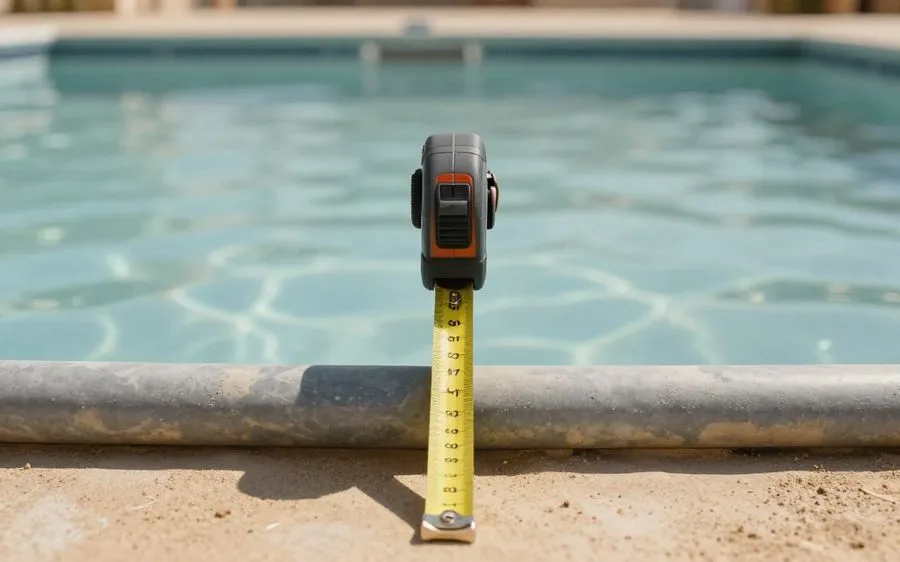
Under A.R.S. 36-1681(B)(5), the barrier must stand at least 20 inches from the water’s edge. The distance prevents the enclosure from being treated as a line drawn right at the pool. Put a tape measure on the finished site, not a rendering.
When the house is one side of the enclosure
“Arizona requires a fully separate four-sided fence” is false. A.R.S. 36-1681(C) gives four alternatives when the residence wall forms part of the enclosure. This is the passage too many installer pages miss, and I have watched homeowners spend on a mesh fence they did not need because of that bad advice.
The first alternative is an interior barrier at least 4 feet high that meets subsection (B)(2) through (B)(5). The second is a motorized cover operated by a key switch and meeting the statute’s cover standard. A loose solar cover or a winter cover is not automatically that alternative.
The third alternative protects the openings in the residence wall. Doors opening to the pool area must be self-latching. Egress windows from sleeping rooms need latches at least 54 inches above the floor. Other windows need screens, a keyed device limiting the opening to 4 inches, or a latch at least 54 inches above the floor. CPSC publication 362 also identifies the UL 2017 alarm specification: a sound lasting at least 30 seconds within 7 seconds after opening, at least 85 dBA at 10 feet, an adult bypass of up to 15 seconds, and a reset at least 54 inches high.
The fourth alternative concerns a qualifying above-ground pool. Its non-climbable sides must be at least 4 feet high, and the ladder or steps must be removable and secured or removed when the pool is not in use. Each path has conditions. None lets an owner simply declare the house side safe.
| Option | What it is | What it requires | Citation |
|---|---|---|---|
| Interior barrier | Barrier between house and pool | At least 4 feet and meets (B)(2)-(B)(5) | A.R.S. 36-1681(C)(1) |
| Motorized cover | Key-switch operated cover | Meets the statute’s cover standard | A.R.S. 36-1681(C)(2) |
| Protected openings | Doors and windows in the house wall | Self-latching doors; sleeping-room and other-window protections specified by the statute | A.R.S. 36-1681(C)(3) |
| Above-ground pool | Pool side functions as enclosure | Non-climbable side at least 4 feet; ladder or steps removed or secured | A.R.S. 36-1681(C)(4) |
The practical question is not which option sounds easiest. It is which one matches the actual house wall, doors, windows, cover, or pool side in front of you. What a compliant pool barrier involves is the next article if you need the construction side of that decision.
Above-ground, inflatable and stock-tank pools
Above-ground does not mean outside the statute. Inflatable and stock-tank pools also fall under subsection (A) if they are at least 18 inches deep at any point, wider than 8 feet, and intended for swimming. There is no separate temporary-pool carveout.
For a qualifying above-ground pool, subsection (C)(4) can let the pool’s own side serve as the barrier when it is non-climbable and at least 48 inches high. The ladder or steps must be removable and secured, or removed, while the pool is not in use. That is an alternative with conditions, not an automatic approval of every raised pool.
Exemptions - and the one your city may override
Subsection (D) lists exemptions: pools existing before the statute’s effective date, public and semi-public pools, agricultural works, jurisdictions that have equal or stricter ordinances, and a residence where every resident is at least six years old. A secondary source reports the effective date as June 2, 1991; verify the statute history before relying on that date for an older pool.
The age-based exemption is a state exemption. It does not erase stricter local law. Phoenix says an approved barrier must remain for the life of the pool, so an owner there should not remove a barrier based solely on every resident being over six. A later alteration or removal can require a new permit under the Phoenix materials.
That local override is why I do not tell a homeowner they are clear from one state-law sentence. Read subsection (D), then read the ordinance and building-department materials where the property sits.
The penalty, and the figure installer pages invented
A.R.S. 36-1681(F) calls a violation a petty offense. It also provides that no fine is imposed if the barrier is brought into compliance within 45 days and the person attends an approved pool-safety course. The statute does not state a dollar amount.
Some installer pages, including claims attributed to FenceMyPool and Security Door Gate & Fence, describe a Class 1 misdemeanor with fines up to $2,500. That conflicts with subsection (F) and is not a figure I would rely on. The point is not that an owner should gamble on enforcement. It is that the statute, not a contractor page, supplies the classification and cure condition.
What your city and county add
The state statute is not the last page. Maricopa County uses local additions to IBC 3109 for pool barriers and requires permit and zoning clearance. Its DD-5012-01 materials have a revision conflict on the engineer-seal trigger: the landing page revised May 4, 2026 says over 7 feet, while the November 20, 2024 PDF refers to 6 feet and 9 feet. Treat the newer landing-page statement as the reported current trigger and confirm it with the county before submitting a plan.
Phoenix uses the 2024 ISPSC with city amendments. Its materials identify a 5-foot barrier, a 4-inch ball test, and 2 inches of ground clearance. They also describe a pre-May 4, 1990, 4-foot inner-yard grandfather provision, pre-gunite and pre-plaster inspections, and no doggie doors on pool doors. The approved barrier stays for the pool’s life.
Mesa’s code materials specify 60 inches above grade on the side facing away from the pool. They identify a pre-April 20, 1998 grandfather provision with alteration triggers, a PAD/DMP exemption, and an ASTM F1346 cover alternative. Chandler adds a 5-foot pool barrier plus a 6-foot minimum perimeter fence. Its guideline also identifies UL 2017 alarms, ASTM F1346 covers, a 48-inch above-ground alternative, a pet-door rule, and locked gate leaves over 4 feet. Chandler says the rule applies whether or not children live there.
| Jurisdiction | Adoption basis | Barrier height | Grandfather date | Notable local rule | Source and date |
|---|---|---|---|---|---|
| Maricopa County | Local additions to IBC 3109 | Verify county application | Not stated here | Permit and zoning clearance; engineer-seal revision conflict | DD-5012-01, rev. 11/20/2024 and 5/4/2026 |
| Phoenix | 2024 ISPSC with amendments | 5 feet | Before May 4, 1990, 4-foot inner-yard provision | Barrier remains for life; no doggie doors; inspections | City of Phoenix Pool Barriers, checked 2026-07-29 |
| Mesa | Title 4, Chapter 10, ISPSC Section 305 as amended | 60 inches exterior-facing side | Before April 20, 1998, with alteration triggers | PAD/DMP exemption; ASTM F1346 cover alternative | Mesa City Code, Ord. 22-0209, checked 2026-07-29 |
| Chandler | Chapter 35 Section 2205 plus IBC Chapter 31 | 5-foot pool barrier plus 6-foot perimeter fence | Verify with city | UL 2017 alarms; pet-door rule; gate leaves over 4 feet locked | Chandler Pool Barrier Guidelines, checked 2026-07-29 |
| Scottsdale, Glendale, Peoria, Surprise, Queen Creek | Local additions not confirmed in the source register | Verify with your city | Verify with your city | Call the building department before relying on an extension | No primary-sourced figures available |
Do not transfer one city row to another. The rules your own city adds is the city-rule series article; this page keeps to the extensions that were documented in the source register.
What people get wrong about the Arizona pool fence law
| Myth | Fact | Statute or source |
|---|---|---|
| A violation is a Class 1 misdemeanor with a stated $2,500 fine. | The statute calls it a petty offense and states no dollar figure; it contains a 45-day cure and course condition for no fine. | A.R.S. 36-1681(F) |
| Arizona always requires a separate four-sided fence. | The house may form part of the enclosure through one of four subsection (C) alternatives. | A.R.S. 36-1681(C) |
| A 4-foot exterior fence is enough. | The exterior enclosure minimum is 5 feet. A 4-foot figure belongs to the interior-barrier alternative. | A.R.S. 36-1681(B)(1), (C)(1) |
| Any pool cover replaces a fence. | Only a key-switch motorized cover meeting the stated standard is one house-wall alternative. | A.R.S. 36-1681(C)(2) |
| An inflatable or stock-tank pool is exempt because it is temporary. | If it meets the 18-inch depth, 8-foot width, and swimming-intent threshold, subsection (A) captures it. | A.R.S. 36-1681(A) |
| No young children live here, so the barrier can come down. | The state exemption may apply, but local rules can be stricter. Phoenix requires an approved barrier for the life of the pool. | A.R.S. 36-1681(D); City of Phoenix Pool Barriers |
I would not reduce this to a slogan. A 4-foot interior barrier, a 48-inch above-ground side, and a 5-foot exterior enclosure can all appear in the same statute, but they answer different questions. When a removable mesh barrier is the answer is a separate material choice, not proof that a given layout meets the law.
Common questions about Arizona pool barrier rules
How tall does a pool fence have to be in Arizona?
It must be at least 5 feet, or 60 inches, measured on the exterior side of the enclosure under A.R.S. 36-1681(B)(1). The roughly 48-inch figure in national guidance is not the Arizona rule. Check the city rule as well because local requirements can add to the state baseline.
What is the real penalty if my barrier does not comply?
The statute makes it a petty offense and provides no fine when the barrier is cured within 45 days and an approved pool-safety course is attended. A.R.S. 36-1681(F) states no dollar amount. The Class 1 misdemeanor and $2,500 claim on some installer pages conflicts with the statute.
Can my house be one side of the pool enclosure?
Yes, if one of the four subsection (C) alternatives applies. The usual house-wall path is protecting every pool door and the relevant windows, though a qualifying interior barrier, key-switch motorized cover, or qualifying above-ground pool can also be an alternative. The exact doors and windows matter.
Does my stock-tank or inflatable pool need a barrier?
Yes, if it is at least 18 inches deep anywhere, wider than 8 feet, and intended for swimming. There is no temporary-pool exemption in the statute. A smaller water container that does not meet those thresholds is a different question, so measure rather than estimate.
All my residents are over six. Can I take the fence down?
The state exemption may apply, but you should not take the fence down before checking local law. Phoenix requires an approved barrier to remain for the life of the pool. A stricter city rule controls over the state exemption.
Does a pool cover count instead of a fence?
Only a key-switch motorized cover meeting the statutory cover standard can serve as a house-to-pool alternative. A solar or winter cover is not a barrier under that option. Do not assume a product is compliant because compliance depends on its performance and installation.
You know the rule. Now measure what you have and run the seven-point self-check on your own enclosure.
Sources
- A.R.S. 36-1681, “Pool enclosures; requirements; exceptions; enforcement” - authority for the requirements, exemptions, and penalty; checked July 29, 2026.
- Maricopa County DD-5012-01 - local adoption and engineer-seal revision conflict; revisions November 20, 2024 and May 4, 2026; checked July 29, 2026.
- City of Phoenix Pool Barriers, 2024 ISPSC with Phoenix amendments - city barrier and inspection rules; checked July 29, 2026.
- Mesa City Code Title 4, Chapter 10, ISPSC Section 305 as amended, Ordinance 22-0209 - Mesa requirements; checked July 29, 2026.
- City of Chandler Pool Barrier Guidelines, Chapter 35 Section 2205 and IBC Chapter 31 - Chandler additions; checked July 29, 2026.
- CPSC Safety Barrier Guidelines for Residential Pools, publication 362 - national baseline and UL 2017 alarm specification.
Last reviewed 2026-07-29. Every requirement is re-read against azleg.gov and the applicable city documents at each review.
Confirm the current statute and your city’s ordinance with the building department before relying on this article. Cities may impose stricter requirements, a barrier is not a substitute for supervision, and no statement here determines that a specific pool enclosure complies.
Reviewed by Alma Reyes, ICC-certified residential building inspector
Read next in pool barriers
Does My Block Wall Count as a Pool Fence? A Self-Check and the Cheapest Compliant Fix
A seven-point self-check for an existing block wall and pool gate, plus the cheapest compliant fix when a check fails - usually the gate, not a new fence.
Want a licensed contractor to call you back?
Leave a number and we pass it to a licensed Arizona contractor. We are not one, we do not bid on the work, and we do not sell your number on.
Request a callback
Send your number to [email protected] with the best time to call and one line about the project. It reaches a person, not an autoresponder, and the page you were reading travels with it so we know what you were pricing.
Advertiser disclosure: this page is free to read because a contractor may pay us for a lead that comes from it. That arrangement never changes what a page says. We publish no contractor names, no rankings and no reviews, and we say plainly when a project is not worth doing.