Block Wall, Fence and Gate Projects in Metro Phoenix
Four families of work, sixteen jobs, and one habit that saves money on every one of them: pin the specification down in writing before the trench is dug. Written for the person paying the bill, not the one sending it.
The job is below the face
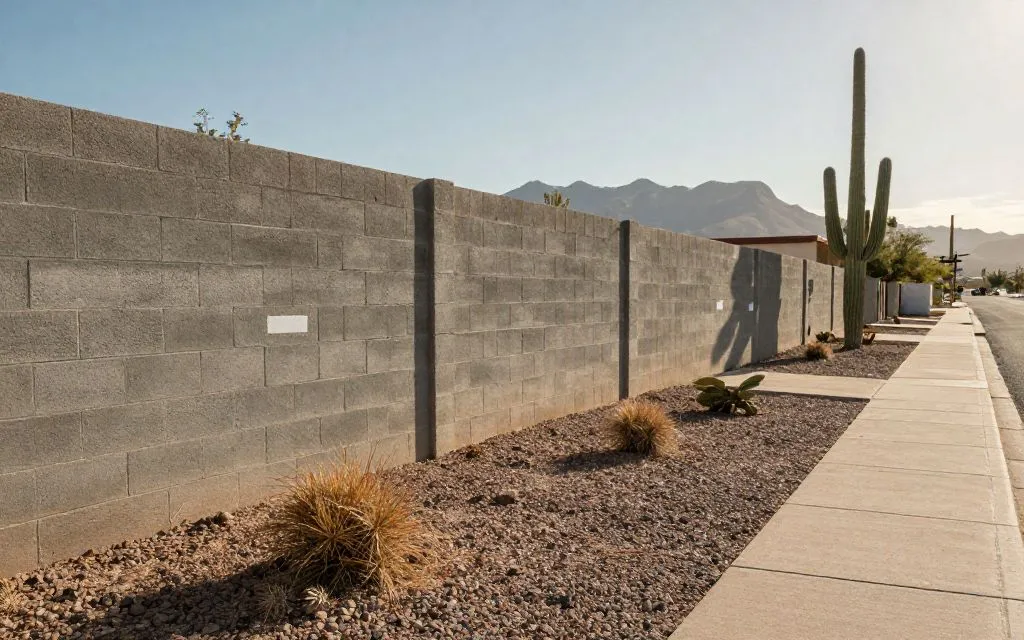
Drive any Valley subdivision and you will see the same product repeated for miles: a gray or stuccoed masonry wall, six feet, running lot line to lot line. That is the default here, not a fence. It matters because a wall is a structure and a fence is an assembly, and the two fail for completely different reasons.
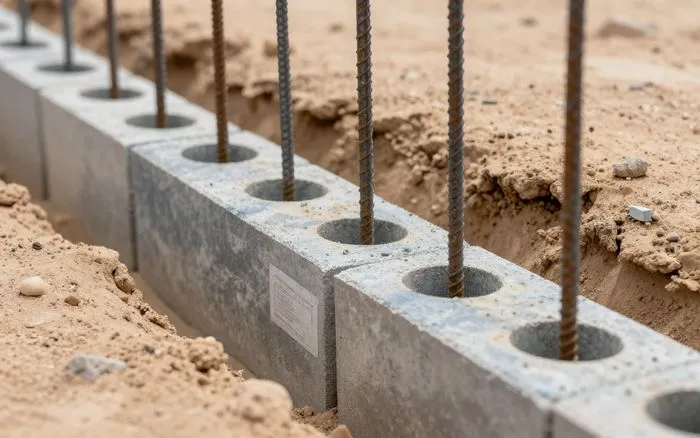
A concrete masonry unit wall stands on a poured concrete footing. Vertical steel is doweled out of that footing and runs up through the hollow cores of the block, and grout fills those cores so the steel, the grout and the block act together as one vertical beam. The mortar joints do the alignment work; structurally they carry very little. Trade practice puts the footing at roughly twice the width of the block it carries, and the block sets the unit everyone quotes in: one course is the nominal height of the block, eight inches. So a six-foot wall is nine courses, and a bid that says "add two courses" means sixteen inches.
Every part of that description is invisible once the last course is laid. You cannot inspect a footing depth, a rebar size or a grout schedule from the sidewalk, and no amount of looking at a finished wall will tell you which of two bids built it properly. That single fact drives everything else on this site.
Which is why the specification has to be explicit before the trench is dug. Afterward, the only evidence you own is the price you paid. What a sound new wall involves, start to finish covers the build itself.
Four families of work, and which one you are buying
People arrive here asking for "a fence quote" and mean four different things.
Walls are the masonry family: a new run, a repair to a cracked or leaning one, added height on an existing one, a retaining wall holding back earth, a finish over bare block. They share a material and almost nothing else. A repair is a diagnosis job before it is a construction job, an extension is a load question about a footing poured years ago by someone who never planned for more weight, and a retaining wall is a drainage problem wearing a masonry costume.
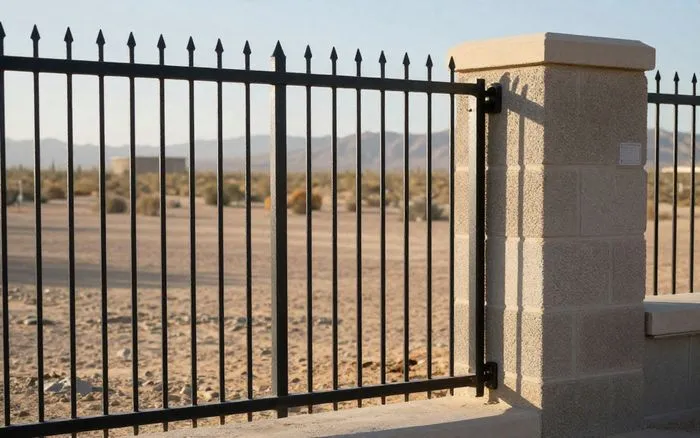
Fences here are the second category, led by tubular steel, which turns up on quotes as view fence and as wrought iron, both meaning the same product. It goes in where a golf course, a wash or a mountain view is worth keeping, and where the community has already decided the style for you. Wood, vinyl and chain link exist, but the sun and the covenant between them push these to the margins.
Gates are priced and engineered separately from the run they sit in. A walk gate, a driveway gate and an RV gate are the same idea at three widths, and the width is not a preference: it is arithmetic against the vehicle and the room the site gives you. Automation is a fourth thing again, closer to an electrical safety system than to a gate.
Pool barriers are the one family where the specification is not yours to choose. Arizona sets a minimum enclosure standard for a pool: at least a five-foot barrier measured on the outside, no opening that will pass a four-inch sphere, and a gate that closes and latches itself and swings away from the water. That is the headline, not the whole standard. Arizona pool barrier law, section by section carries the statute properly, and the self-check for an existing wall answers the question most Valley owners actually have, which is whether the wall they already own qualifies.
Choosing between families rather than within one is a comparison question. The head-to-head comparisons put block against iron, vinyl and wood, and privacy against a view.
Two approvals, in this order, plus one phone call
Almost every Valley project passes two independent gates, and the order is not interchangeable. Take them backward and you can end up paying for the same wall twice.
Start with the community. Most subdivisions built here in the last forty years are covenant-governed, and the architectural committee regulates height, material, color and style through the CC&Rs. Get that approval in writing before you apply to the city, because a covenant can force you to change or remove a wall that the city was perfectly happy with. How the ARC process actually runs, and what to send them walks through the paperwork and the timeline.
The city is the second gate, and it is not one gate. Each Valley jurisdiction adopts its own edition of the building code with its own amendments, and the height at which a permit becomes mandatory is set locally. Contractor sites publish that trigger as though it were one number for the whole metro. It is not: figures of one foot, three feet and six feet all circulate, each of them true somewhere. The permit process, jurisdiction by jurisdiction and the by-city table of triggers and height caps are where the real answer for your address lives, and what your own city requires opens the city page directly.
Above certain heights the county wants an engineer. The Maricopa County directive revised on 5/4/2026 requires plans sealed by an Arizona registered professional for walls over seven feet, and for retaining walls over four feet measured from the bottom of the footing to the top, or carrying a surcharge. Cities can be stricter. That line is the practical boundary between a routine wall and a designed one.
Then there is the call that costs nothing and is not optional. Arizona 811, a name that never quite displaced the old one, Blue Stake, marks buried utilities free of charge, and state law requires notice at least two full working days before excavation. A footing trench counts as excavation, and so does a post hole.
One more thing belongs in this section, because it decides who may hold the shovel. Contractors in Arizona are licensed by the Registrar of Contractors under classifications that match scope: R-31 for masonry, R-21 for hardscape work capped at walls of six feet and retaining walls of three, B-4 for general residential appurtenances, B-5 for pool barriers. A license in the wrong classification is not a technicality. Hiring outside the licensing system also forfeits the state's consumer backstop, including the recovery fund, which is reported at up to $30,000 per license under A.R.S. 32-1132. Confirm the current cap with the Registrar rather than relying on that figure, and note that complaints generally have to be filed within about two years.
What moves the number
A per-foot price for this work does not exist in any honest form, which is why every contractor site that publishes one is selling you something. Price is assembled from drivers, and the drivers rank roughly like this.
Length sets how much structure there is. Height then multiplies it out of proportion: an added foot is commonly quoted at something like a fifth to a quarter more, because a taller wall is heavier, its footing is wider and its steel schedule changes.
Soil is the wildcard, and in this valley the wildcard has a name. Caliche is a cemented layer sitting under much of the Valley at a depth nobody can predict from the curb, and hitting it turns a routine trench into equipment work. It is the line that gets paid for far more often than it gets asked about.
After that come reinforcement and grout, block grade, the finish, demolition and haul-off of whatever is there now, engineering when it is triggered, and permit fees.
Surface area and linear feet do different jobs in a quote. Stucco and paint follow square footage of face. Footing, steel and grout follow linear feet at a stated height. Gates price per installed gate, with automation as its own system. A quote that rolls all of that into one round number is not a simpler quote, it is a less checkable one.
The full cost breakdown, line by line holds the rate table, the estimator does the arithmetic, and how to read competing quotes shows where padding usually hides.
The bid-spec checklist
This is the part no contractor page publishes, because it is the part that makes bids comparable. Take any quote and check whether it states each of these in writing. A bid that answers all of them may still be expensive; a bid that answers half of them cannot be compared to anything.
| What the quote must state | Why it decides the outcome | Missing means |
|---|---|---|
| Footing width and depth | Sets whether the wall has a foundation for its height and soil | You are buying an unknown foundation |
| Rebar size and spacing, vertical and horizontal | Code sets a minimum, roughly one #4 bar at four feet on center, and field practice often goes tighter; the difference is invisible later | The cheapest legal option, or less |
| Grout schedule, which cores are filled | Ungrouted cores mean the steel is decorative | The wall is not the beam you think it is |
| Bond beam at the top, and at what course | Ties the wall together against wind and movement | A row of separate columns |
| Block type, grade and dimension | Determines strength, face and course height | Substitution at delivery |
| Drainage: weep holes, backfill, where water goes | The single most common cause of retaining failure is hydrostatic pressure | The most likely failure mode is unaddressed |
| Finish, and how many coats over what prep | Coating over efflorescence guarantees the finish fails | You pay twice |
| Demolition and haul-off scope | Removing an old wall is real money and often excluded | A change order after work starts |
| Who pulls the permit, and whose name is on it | Liability and inspection responsibility | It becomes yours by default |
| License classification for this scope | R-31, R-21, B-4 and B-5 cover different work | No recovery fund if it goes wrong |
| Utility locate before excavation | State law, and free | Somebody is planning to dig blind |
Price is not the only thing a bid can be wrong about. Watch for a repair priced before anyone investigated the footing, a finish priced over visible white bloom, and an automation package that never mentions entrapment sensors. Watch hardest for the bid that comes back materially cheaper than the others while describing the same job in fewer words: the savings are in the lines it left out.
What actually goes wrong here
The desert does not attack the face of a wall. It works underneath it.
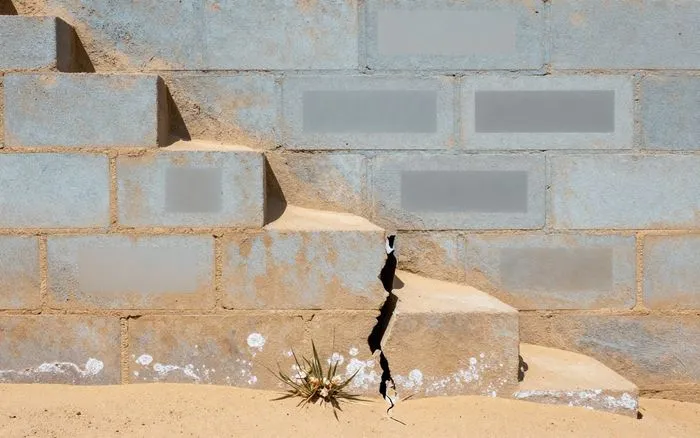
Soil moves. Expansive clay swells and shrinks with the monsoon cycle, caliche perches water where it should drain, and a footing that coped fine on a dry day in May gets its real test in August. When a wall in this metro leans, cracks in a stair-step pattern or drops a section, the cause is almost always water and soil rather than the block itself. That is why a crack diagnosis has to come before a repair quote, and why the drainage rows on the checklist above matter more than the block grade.
Sun does the rest. Ultraviolet breaks down the lignin in wood and the plasticizers in vinyl, and surface temperatures out here punish both in ways that the manufacturer's national lifespan claim never mentions. Steel and masonry shrug at it. Taste is not why the Valley looks the way it does; the sun sorted these materials long before any homeowner chose between them, which is worth reading about before you fall for a material: vinyl in this sun, wood in this sun.
White powder on a wall is efflorescence, salt left behind by water moving through the masonry. It is a moisture report, not a cleaning problem. Painting or stuccoing an existing wall starts there.
The sixteen projects, and what each one settles
| Project | What the page settles | Group |
|---|---|---|
| New Block Wall Installation in Phoenix | the whole build sequence, and why the cost and the risk both sit below ground where nobody can inspect them afterward. | Walls |
| Block Wall Repair: Cracks, Lean and Collapse | a cracked or leaning wall is a footing, drainage or soil failure; the diagnosis is the job, and a patch quote is the warning. | Walls |
| Adding Height to an Existing Block Wall | the gate is structural rather than aesthetic: the old footing was never designed for the added load, and that has to be proven first. | Walls |
| Retaining Wall Construction in Phoenix | it holds back earth, so it lives or dies by drainage, and it crosses the engineering threshold sooner than owners expect. | Walls |
| Blocking a Two-Story Neighbor's View, Legally | the honest answer is often that a taller wall is neither permitted nor effective against an elevated sightline. | Walls |
| Stucco or Paint on an Existing Block Wall | the white bloom is the story; coating over moisture guarantees the finish fails. | Walls |
| Wrought Iron and View Fence Installation | the deciding constraint is usually the covenant rather than the material, because the community picks the style and post spec before you do. | Fences |
| Chain Link Fence: The Budget Perimeter | its limit is social rather than technical: among the most durable options here, and among the most often banned. | Fences |
| Vinyl Fence in Desert Sun | grade decides everything, and the covenant may settle the question before grade gets a vote. | Fences |
| Wood Fence in Desert Sun | the highest-maintenance choice in this climate, where the real price is the recurring one. | Fences |
| Driveway Gate Installation: Swing or Roll | geometry decides: swing needs leaf clearance and hates slope, roll needs lateral room and tolerates it. | Gates |
| RV Gate Installation and Sizing | sized to the actual vehicle, mirrors included; an opening the RV cannot clear is the region's most expensive do-over. | Gates |
| Walk and Side-Yard Gate | small job, one catch: inside a pool enclosure a walk gate is barrier hardware, and a plain latch there is a safety failure. | Gates |
| Gate Openers and Automation: The Safety Layer | automation is life-safety equipment, and monitored entrapment protection is exactly what DIY kits leave out. | Gates |
| Pool Barrier and Pool Fence Installation | child-safety equipment rather than decoration: the enclosure standard sets height, gaps and gate hardware, not taste. | Pool barriers |
| Removable Mesh Pool Fence | it protects only while it is up and latched, which makes the failure mode human rather than material. | Pool barriers |
Questions this hub answers
Is a block wall or a fence the default around here?
A block wall. The standard residential barrier in metro Phoenix is masonry, usually six feet, with tubular steel view fence as the second real category wherever a view or a covenant calls for open steel. Wood, vinyl and chain link are minority choices in this market, and the sun is one reason.
Do I need HOA approval before the city permit, or after?
Before, and in writing. The architectural committee can require changes or removal even on a finished wall that meets city code, and the city will not step in to protect you from that. Reversing the two is how people end up rebuilding something a city inspector already passed.
Do I really have to call 811 before digging a footing?
Yes, and it costs nothing. State law requires notice at least two full working days before excavation, and a footing trench or a post hole is excavation. The locate service marks buried utilities so the crew is not digging blind.
Why is one quote so much cheaper than the others?
Read it for what it does not say. Run all three bids down the checklist above, row by row, and the comparison stops being a matter of judgment: the cheap bid is usually the one with the most empty cells, and none of those cells can be inspected once the wall is up.
What is caliche, and why does everyone mention it?
A cemented soil layer found across much of the Valley at a depth you cannot predict from the surface. It slows footing excavation and sometimes calls for heavier equipment, which is how two quotes for the same wall diverge on soil alone. Worth asking which of your bidders priced for it and which one is hoping.
When does a wall need a stamped engineer's drawing?
Above the county threshold. The Maricopa County directive revised 5/4/2026 requires sealed plans for walls over seven feet, and for retaining walls over four feet measured from the bottom of the footing to the top, or with a surcharge such as a slope or driveway above. Individual cities can set a lower bar, so confirm locally.
This site publishes general information about wall, fence and gate work in metro Phoenix. It does not perform this work, does not accept work, and cannot certify that any specific wall, barrier or gate complies with the code that applies to your address. Permit triggers, height limits and pool-barrier requirements are set locally and change; verify them with your city and with your community's architectural committee before you build. Reviewed by Alma Reyes, ICC-certified residential building inspector.
Want a licensed contractor to call you back?
Leave a number and we pass it to a licensed Arizona contractor. We are not one, we do not bid on the work, and we do not sell your number on.
Request a callback
Send your number to [email protected] with the best time to call and one line about the project. It reaches a person, not an autoresponder, and the page you were reading travels with it so we know what you were pricing.
Advertiser disclosure: this page is free to read because a contractor may pay us for a lead that comes from it. That arrangement never changes what a page says. We publish no contractor names, no rankings and no reviews, and we say plainly when a project is not worth doing.