Removable Mesh Pool Fence
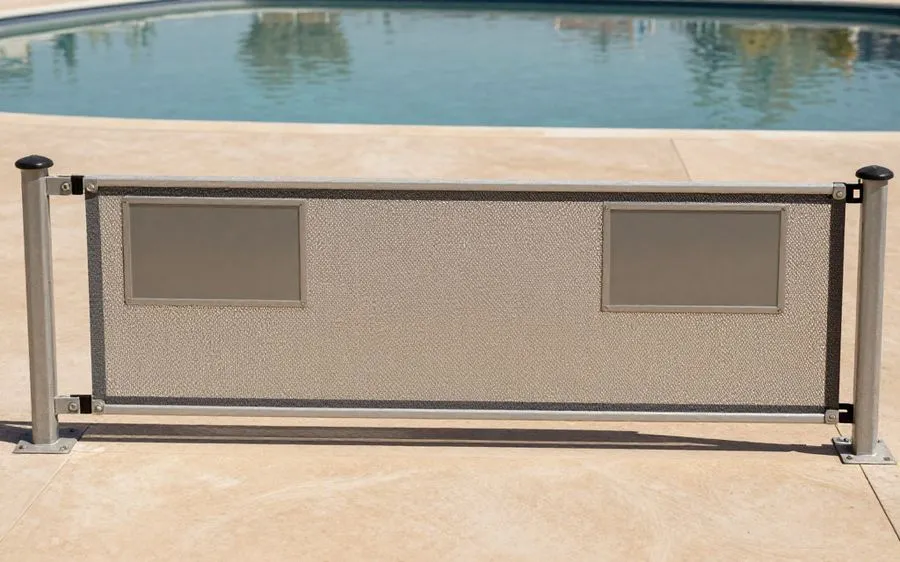
A removable mesh pool fence is not a lesser kind of barrier just because an adult can take it down. In Arizona, the question is whether the installed barrier performs to the required standard. That distinction matters in metro Phoenix, where a pool may sit behind a block wall that does not do all the work the enclosure needs.
Yes - while it is up
Yes, a removable mesh pool fence can be a legal pool barrier in Arizona while it is installed and latched. A.R.S. 36-1681(B) sets performance requirements rather than reserving compliance for one material or a permanent wall. A mesh system that meets those requirements is a legitimate option.
The last part is where homeowners can fool themselves. The fence protects only while it is up and the gate is latched. Pull the panels out after a swim, leave the gate section propped, or delay putting it back, and you have changed the protection around the pool without changing anything about the product.
I have seen people call a removable barrier a temporary safety measure as if temporary meant casual. It does not. The job is simply different: a wall stays in place without being asked; a mesh fence depends on someone doing the last step every time.
The ground rules
Phoenix is a wall-first market, but a wall may need an interior barrier to make the pool enclosure work. Start with two approvals in order: the barrier requirements that apply to the property, then any local permit question. A permit may apply, so verify locally before the installer drills.
The utility locate call is usually not triggered by this installation because sleeves are drilled into the deck rather than a trench being dug through the yard. That does not turn the deck into a blind drilling zone. Ask the installer how the sleeve locations are laid out around existing deck conditions.
What it must satisfy
While installed, the barrier needs to meet the same headline performance rules as other pool barriers: at least 5 feet high, no opening that passes a 4-inch sphere, and a non-climbable surface. The gate section must be self-closing, self-latching, and open outward. Those are the requirements in the rule, not optional upgrades for a mesh product.
For the removable system itself, ask about ASTM F2286. That standard addresses removable mesh fencing systems; it is not a substitute for checking the completed enclosure against the applicable barrier requirements. The CPSC barrier guidance also explains the 4-inch-sphere approach behind the opening limit.
No seller can certify your specific yard from a brochure. A change in grade, a side gap, or the gate arrangement can decide whether the installed barrier works as intended.
How it is installed
The installer lays out sleeve locations at set spacing, drills the deck-sleeve holes, and seats the sleeves. Poles go into those sleeves, tensioned mesh panels run between them, and the gate section is fitted with the required barrier hardware. The finished fence is designed so an adult can remove and reinstall it.
For a standard pool, installer sources commonly describe the work as taking about a day. That is an estimate, not a promise for your deck or layout. Curves, access, the number of panels, and the gate position all affect the day.
The sleeves stay when the fence is down. That detail gets missed in a sales conversation, then becomes the first thing a homeowner notices after the poles come out.
The weakness is the habit, not the mesh
Mesh is not the weak link. The household routine is. A barrier left down after visitors leave, or a gate section held open for convenience, gives you no barrier at that moment.
That is not a moral lecture. It is a buying question. A removable barrier asks something of the household that a wall does not: somebody has to put it back up, promptly and completely, after every removal. If the answer is “probably” because everybody assumes somebody else will do it, I would not buy the removable option.
I learned this lesson in a different form after a footing call I made failed during monsoon weather. The material was not at fault. My assumption about what would happen after I left was. Safety barriers deserve the same unsentimental thinking.
The honesty test
Before buying, answer these questions: Who puts the barrier back up? How quickly does that happen? What happens on the day nobody does? If those answers are uncomfortable, buy the permanent barrier.
When it is the right choice
A removable mesh pool fence can make good sense where a perimeter wall cannot be made compliant on its own, or where the enclosure needs an interior barrier between the house and pool. It also suits a home being sold, a rental arrangement, a yard that will change, or a pool used seasonally.
The lower commitment is real, and so is the compliance while the system is in place. Compare it with the permanent barrier this replaces or supplements before treating either choice as automatic.
| Factor | Removable mesh | Permanent barrier |
|---|---|---|
| Compliance while in place | Can meet the barrier requirements while installed and latched | Can meet the barrier requirements when built and maintained to them |
| What it asks of the household | Reinstall it and keep the gate section latched after removal | Maintain the enclosure and gate hardware |
| Installation disruption | Deck sleeves are drilled and panels are set | Depends on the barrier construction and site work |
| Reversibility | Panels and poles can be removed by an adult | Not designed for routine removal |
| Relative cost | Depends on linear feet, sleeves, spacing, and gate section | Compare the full scope, not a material label |
| What happens when the house changes hands | New owners need the routine and all components | The physical barrier remains in place |
What moves the price
Linear feet lead the quote, but pole spacing, the gate section, deck sleeves, and deck material all move it. A single undated commercial source quotes roughly $15-$25 per linear foot installed. Treat that as a rough relative signal, not a current market rate or a bid for your pool.
For a real price comparison, use the cost breakdown after you know the fence length, deck conditions, and gate scope. A cheap-looking per-foot number tells you little if the gate and sleeves are outside it.
Reading the quote
Ask for the specifications in writing. “Pool fence included” is not a useful scope line when the safety details are the work.
| Quote item | What to ask for |
|---|---|
| Installed height | State the installed height and how it is measured |
| Mesh and gap specification | Identify the mesh system and the opening limitation |
| Pole spacing and sleeve type | Show the spacing, sleeve type, and deck locations |
| Gate section hardware | Identify the outward-opening, self-closing, self-latching hardware |
| Product standard | State whether the removable mesh system is specified to ASTM F2286 |
| Compliance verification | Name who verifies the completed barrier and which local requirements they are checking |
Then ask the questions that expose a thin quote: “Show me the gate self-closing.” “What do the sleeves look like when the fence is down?” Also ask whether a local permit applies. If the answer is vague, pause before signing and review checking what you have.
Frequently asked questions
Is a mesh pool fence legal here?
Yes, a mesh pool fence can be legal when it meets the barrier specifications while installed. Its removability does not lower the required performance standard, and it protects only while installed and latched.
Does it have to meet the same rules as a wall?
Yes, it has to meet the same performance rules. The legal focus is the barrier’s height, openings, climb resistance, and gate operation rather than whether it is a wall or a removable mesh system.
What happens when it is down?
When it is down, you have no barrier from that mesh fence. That is the entire risk, which is why the household routine matters more than a sales claim about convenience.
How much does it cost?
One undated commercial source commonly quotes about $15-$25 per linear foot installed. Use it only as a rough signal because linear feet, sleeve work, spacing, the gate section, and deck material change the installed scope.
Will the deck sleeves damage my deck?
Deck sleeves are permanent fittings in the deck, so ask what they will look like with the fence removed. A capped sleeve can sit flush in concrete, but the quote should state the sleeve type and finish rather than leaving that detail to assumption.
Before you buy any barrier, run the self-check on the enclosure you already have.
Sources
- A.R.S. 36-1681, checked July 29, 2026, especially subsection (B).
- ASTM F2286, removable mesh fencing system standard.
- CPSC publication 362, pool barrier guidance and the sphere-test rationale.
- nmifence.com, undated installed-cost signal used only as a rough reference.
Last reviewed July 29, 2026.
This article is general information, not a compliance determination for a particular pool. A barrier is one layer of protection and does not replace active supervision. Confirm the requirements that apply to your property before installation.
Reviewed by Alma Reyes, ICC-certified residential building inspector.
Read next in projects
Adding Height to an Existing Block Wall
What raising an existing block wall in metro Phoenix really involves: the footing calculation, the permit, how new block ties to old, and where it is not allowed.
New Block Wall Installation in Phoenix
What a new block wall in metro Phoenix involves, what drives its price, the permit and engineering triggers, and what a sound quote must spell out.
Block Wall Repair: Cracks, Lean and Collapse
How to tell a cosmetic crack from a structural one in metro Phoenix, why block walls lean here, the repair options by severity, and what a quote must state.
Want a licensed contractor to call you back?
Leave a number and we pass it to a licensed Arizona contractor. We are not one, we do not bid on the work, and we do not sell your number on.
Request a callback
Send your number to [email protected] with the best time to call and one line about the project. It reaches a person, not an autoresponder, and the page you were reading travels with it so we know what you were pricing.
Advertiser disclosure: this page is free to read because a contractor may pay us for a lead that comes from it. That arrangement never changes what a page says. We publish no contractor names, no rankings and no reviews, and we say plainly when a project is not worth doing.