HOA Approval for a Wall or Fence in Arizona: The ARC Process, the Timeline and Which Approval Comes First
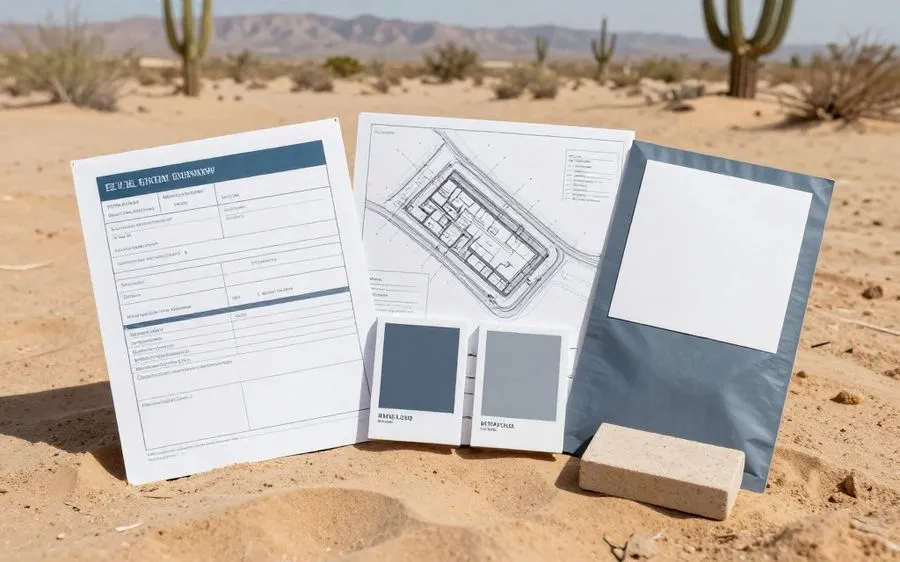
I have watched more wall projects stall at an architectural committee than at a permit counter. The projects that moved were rarely the fanciest. They arrived with a complete packet, a readable site plan, and a written answer before anyone ordered block. That is the job here: treat your association and your city as two separate gatekeepers, then put them in the right order.
This is a buyer’s guide, not legal advice. For a fine, lien, enforcement letter, or demand to remove a wall, consult an association or real-estate attorney. Your community approval and a city permit are independent approvals, and neither replaces the other.
Two gatekeepers, testing two different things
A city permit asks whether the proposed work meets public building and land-use rules. An association’s architectural approval asks whether the same work fits the private restrictions you accepted with the property. A city does not enforce your covenants. Your association cannot issue a building permit. The two approvals are independent, which is the point homeowners most often miss when they have already paid for plans.
In many newer Phoenix-area subdivisions, recorded covenants put exterior walls and fences in front of an architectural review committee, usually called an ARC. The committee may care about a stucco color that has nothing to do with city safety rules. The city may care about a condition the committee never reviews. Passing one counter does not get you past the other.
| Dimension | City building permit | Community association approval |
|---|---|---|
| Who issues it | The city or town with jurisdiction over the property | The association’s architectural committee or board under the CC&Rs |
| What it tests | Public safety and land-use compliance | Design and covenant compliance |
| Basis of authority | City code and building rules | Recorded CC&Rs and Arizona planned-community law |
| What it controls | Structural adequacy, applicable height limits, setbacks, and sight-triangle concerns | Material, color, style, finish, placement, and any stricter community height cap |
| Review window | The city’s process | The time stated in your own CC&Rs or design guidelines |
| Cost | A city filing fee may apply | The governing documents may set an application charge |
| What you submit | The documents the city requires | ARC form, site plan, elevations, samples, contractor information, and any requested photos |
| If you skip it | The city can enforce its rules | The association can fine, require a change or removal, and use its statutory lien authority for unpaid assessments |
| Which to seek first | After written association approval in the usual case | First, because it can reject a design the city might otherwise accept |
Arizona’s Planned Communities Act provides the framework for the association side, while city rules supply the public-law side. Read them as separate tracks. If a manager says, “The city signed off,” ask where the architectural approval is. If a committee says, “We approved it,” ask what the city requires next.
What the association actually controls
The committee’s practical territory is visible design. It may specify block or fence material, a color family, stucco or bare-block finish, a style, the placement relative to neighboring homes, and a height cap lower than the city allows. That can feel arbitrary when a city counter has no objection. It is still a covenant question the association is entitled to review under its governing documents.
I once priced a wall that met the public rule but did not match the subdivision’s required finish. The owner had treated the city sketch as a complete green light. It was not. Changing the finish after the wall was up cost more than putting the right finish on the ARC drawing at the beginning.
The city, by contrast, reviews public requirements such as structural adequacy, applicable height limits, setbacks, and sight-triangle issues. For that separate side of the project, see the city height limits your committee cannot waive. The committee can be stricter about its own design controls; it cannot waive the city’s rules for you.
Uniformity is why many committees spend real time on a wall that looks simple from the street. A run of perimeter walls in matching color and finish is not accidental. The finish question most committees decide for you is often where a practical project turns into a resubmittal.
The ARC, and what it is required to be
An ARC is not merely a property manager’s inbox. Under A.R.S. 33-1817(B)(1), the architectural committee must include a board member, and that board member chairs it. In practice, you may submit through a management company and never speak to the committee directly. That does not turn the decision into an informal office preference.
The standard worth keeping in front of you is in A.R.S. 33-1817(B)(3): approval shall not be unreasonably withheld. It does not mean every proposed wall wins. It means the association needs a real covenant or guideline basis for its decision and cannot use architectural review as a blank check.
Start by locating the CC&Rs, architectural guidelines, and application form. Search the documents for “architectural,” “modification,” “prior written approval,” and “review period.” Save the version you used. A manager’s email may explain a rule, but the recorded documents are where you check the rule itself.
What to submit
Submit once, not in fragments. In my bidding years, incomplete packages were the ones that went around the block twice because the committee had to ask basic questions the owner could have answered on page one.
ARC submittal checklist
- ARC form: identify the modification type, location, dimensions, color, materials, and contractor.
- Site plan: mark the proposed wall or fence on the lot, nearby structures, property lines, gates, and the street or neighboring lots that make it visible.
- Elevations: show the height, finish, and the change where the design steps up or down.
- Material and color samples: include the block, stucco finish, paint chip, or fence finish the guidelines ask you to identify.
- Contractor details: provide the contractor name and license class when the form asks for it. Check the license separately; do not assume a logo on a proposal settles that question.
- Photographs: add current views of the affected area where the community requests them.
- Dated delivery: submit through the stated portal, certified mail, or another method that gives you a date and a copy of the package.
A city permit approval letter can be useful supporting evidence when you have one, but it is not a substitute for the ARC packet. I would attach it as supporting material, not lead with it as though it ends the discussion.
Illustration only: a Rancho Sahuarita-style packet. One Arizona community’s ARC form asks for the type of modification, location, size, color, materials, and contractor, with a plot plan and supporting materials. Its CC&Rs also describe a review period. That form is a useful picture of a complete packet, not a rule for your subdivision. Your own documents control.
For a street-facing view fence, the committee may focus on visual consistency before anything else. The fence style many communities require on street elevations can help you identify the style question before you choose materials.
How long they have - and why no statute says thirty days
Thirty days gets repeated as if it were an Arizona statute. It is not. A.R.S. 33-1817 does not set a statutory deadline for a wall or fence architectural review. A 30-day period is common in covenants, including the Rancho Sahuarita illustration, but that makes it a covenant figure, not a statewide legal deadline.
Look for four things in your own CC&Rs or guidelines: the number of days allowed for a complete application, what makes an application complete, how a decision must be delivered, and whether silence has any stated effect. Some documents describe a deemed approval after a stated period. Others do not. Silence is covenant-specific, not statutory.
Do not rely on a phone call that the packet is “probably fine.” Send the whole packet by a dated method, keep a PDF of every item, and calendar the review window stated in the documents. If the window runs without an answer, send a short written follow-up that names the submission date and asks whether the governing documents treat nonresponse as approval. That record matters if the dispute becomes a board issue later.
If they say no
A denial is the point to get more precise, not louder. Ask for the denial in writing and ask the association to identify the specific covenant, rule, or architectural guideline it applied. Then compare the cited language against your packet. Did the rule exist in writing? Does the proposal actually violate it? Is the association applying the same rule to comparable visible changes?
The statutory standard is that architectural approval shall not be unreasonably withheld under A.R.S. 33-1817(B)(3). Quote that standard carefully in a request for reconsideration, along with the exact section you believe supports the design. My advice is blunt: do not accuse a committee of bad faith in the first email. Make it show its work first.
Move up the association’s stated ladder. That may mean a revised packet, a request for committee reconsideration, then an appeal or written request to the board. Keep the request about the design and the governing text. A city approval will not force an association to accept a color, style, or placement that its documents validly restrict.
Association powers are bounded. A.R.S. 33-1816, for example, says an association cannot prohibit solar devices. That example does not decide a wall case, but it is a useful reminder that “the HOA can do anything” is not the law either.
When a demand to remove work, a lien threat, or a substantial fine is on the table, take the documents and correspondence to an association attorney. That is the point where a generic online answer becomes expensive. I have seen owners save a few days by ignoring a denial, then spend months untangling a wall that had already been built (and no, the installer cannot solve a covenant dispute for you).
Which approval first, and why
Get written association approval first. Then apply for the city permit if the city requires one. The association can reject a design that the city would happily permit, so city-first can leave you with a filing fee and plan-review time spent on a design you cannot build under the CC&Rs.
There is one sensible exception: go to the city first when its answer will determine the design the committee needs to review. A city answer about a condition affecting the proposed design may change the location or form of the wall. In that narrow situation, ask the city enough to settle the design question, then bring that answer back to the ARC before you pay for a final filing. The full city process belongs in the city permit that comes after the committee says yes.
Order-of-approvals decision tree
Are you in a planned community with recorded covenants?
- No or not sure: check the recorded documents anyway. If there is no architectural-control requirement and the work does not trigger a city permit, neither approval may apply. That is rare enough that I would verify it in writing before construction.
- Yes: is the wall or fence visible from the street or a neighboring lot?
- Yes: association first, then city if needed. Visibility is where material, color, finish, style, and placement review usually matter most.
- No: association first is still the default if the CC&Rs require prior approval. Less visibility does not erase the covenant.
- Does the city’s answer determine the design the ARC will review? If yes, obtain that narrow city answer first, then submit the design to the association. Do not treat a preliminary city answer as permission to start work.
Written approval is the useful kind. File it with your plan, quote, and any city paperwork. A verbal “should be okay” from a manager is not a construction document.
Building without approval
Building before approval turns a paperwork problem into an enforcement problem. The association may issue fines under its documents, demand that you modify or remove the work, and pursue the remedies allowed by its covenants and Arizona law. Under A.R.S. 33-1807, associations have lien authority for unpaid assessments. A dispute over a wall can therefore become attached to the property, not just an unpleasant email exchange.
Arizona’s lien and foreclosure provisions were amended in 2025. I would not print a current threshold here without re-reading the present statute. If a letter mentions a lien, foreclosure, or collection action, check the current text of A.R.S. 33-1807 with an association attorney rather than relying on a number from an older article.
Do not let a violation letter sit in a drawer. Request the governing provision in writing, confirm any response deadline, preserve your approval record and photos, and get qualified legal advice before agreeing to a removal schedule. A wall built to the wrong approval standard is still a wall someone may have to pay to change.
Myth vs fact
| Myth | Fact |
|---|---|
| The city permit covers the HOA. | No. The city permit and association approval are independent. |
| The HOA has 30 days by law. | No Arizona statute supplies a wall or fence review deadline. Your CC&Rs may use 30 days, but that is a covenant rule. |
| If they do not respond, it is approved. | Only if your governing documents say silence has that effect. It is not a statewide statutory rule. |
| The HOA cannot stop me if the city said yes. | It can enforce valid architectural restrictions on material, color, style, height, or placement, subject to the rule that approval may not be unreasonably withheld. |
Common questions about HOA wall and fence approval
Does my HOA have to approve my fence?
In a planned community whose covenants require prior written approval for exterior changes, yes. That approval is separate from a city permit, so read the CC&Rs before you sign a construction agreement. If the documents are unclear, ask the manager for the applicable section in writing.
How long does the HOA have to decide?
No Arizona statute sets a deadline for a wall or fence review. Your CC&Rs set the window; 30 days is common but it is a covenant figure, not a rule of Arizona law. Check whether the clock starts when you submit or when the committee calls the packet complete.
Can the HOA say no to a wall the city would approve?
Yes, it can deny a wall on material, color, style, height, or placement under valid community rules. Approval may not be unreasonably withheld under A.R.S. 33-1817(B)(3), so ask it to identify the exact provision it is enforcing. A written denial gives you something concrete to review.
Which do I do first, the HOA or the city?
Get the association’s written approval first, then deal with the city permit. Otherwise, you can pay a filing fee for a design the association rejects. City-first is reasonable only when the city’s answer will determine the exact design the ARC must review.
They approved it, but the city denied the permit. Now what?
Address the city’s objection and reapply; the association cannot issue a permit. The issue may involve the proposed height, setback, engineering, or another public requirement. Go back to the ARC if resolving it changes the approved design.
They are fining me for a wall I already built. Can they make me remove it?
Possibly. Covenants can be enforced, and associations have lien authority under A.R.S. 33-1807 for unpaid assessments. Ask for the written provision and take a lien threat or removal demand to an association attorney.
Assemble the submittal once, get the approval in writing, and only then file with the city. Phoenix Fence Guide does not perform construction work or act for your association.
Sources
- A.R.S. 33-1817, sections B(1) and B(3): architectural committee composition and the standard that approval shall not be unreasonably withheld.
- A.R.S. Title 33, Chapter 16: Arizona Planned Communities Act and the framework for association authority.
- A.R.S. 33-1816: association restrictions on solar devices.
- A.R.S. 33-1807: association lien authority. The statute was amended in 2025; re-read the current version before relying on lien or foreclosure provisions.
- Rancho Sahuarita Village 4.3(b) CC&Rs and ARC form: labeled illustration of a review window and a typical submittal, not a general rule.
Last reviewed 2026-07-29.
This article is not legal advice. For a lien, fine, enforcement letter, or removal demand, consult an association or real-estate attorney. Review deadlines and the effect of silence come from your own CC&Rs, and Arizona lien provisions were amended in 2025, so current statute text must be checked. This site performs no work and is not your association.
Reviewed by Alma Reyes, ICC-certified residential building inspector
Read next in permits and approvals
Do You Need a Permit for a Wall or Fence in Metro Phoenix? The City Process, Fee and Blue Stake Call
Which metro Phoenix cities require a wall or fence permit and above what height, what the fee is based on, plus the Blue Stake call and the license to check.
How high a wall can be in the front, side and rear yard, what the corner-lot sight triangle cuts it to, and how a retaining wall is measured and triggered.
Want a licensed contractor to call you back?
Leave a number and we pass it to a licensed Arizona contractor. We are not one, we do not bid on the work, and we do not sell your number on.
Request a callback
Send your number to [email protected] with the best time to call and one line about the project. It reaches a person, not an autoresponder, and the page you were reading travels with it so we know what you were pricing.
Advertiser disclosure: this page is free to read because a contractor may pay us for a lead that comes from it. That arrangement never changes what a page says. We publish no contractor names, no rankings and no reviews, and we say plainly when a project is not worth doing.