RV Gate, Driveway Gate and Walk Gate Cost in Phoenix (With Automation)
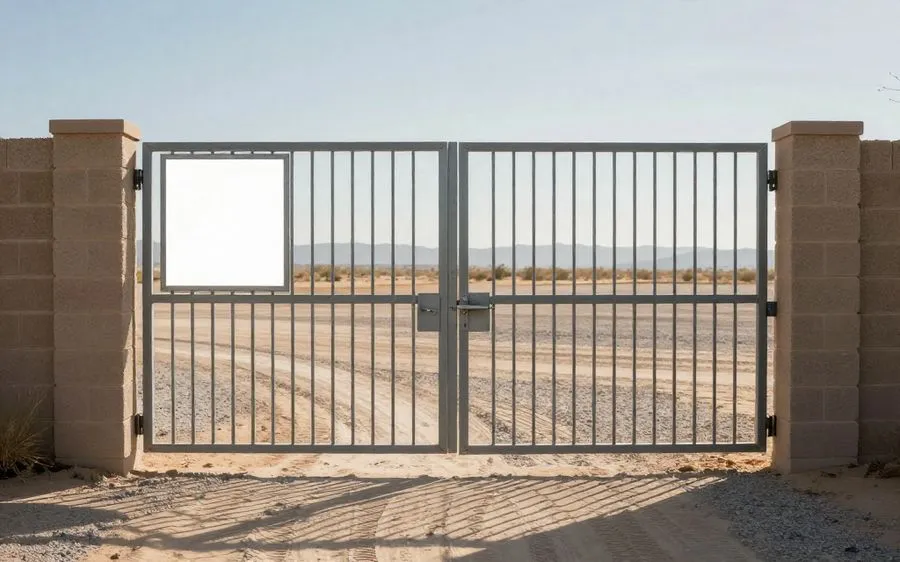
Gate prices get useless fast when the quote never says how wide an opening it buys. I have watched homeowners compare a tidy gate number with a much larger project, then find out their trailer cannot use the opening. Start with the clear opening your vehicle needs. Everything else follows it.
Phoenix Fence Guide does not sell gates or perform gate work. I am giving you commercial price ranges, not a bid. What the wall itself costs per linear foot is a separate question when a new wall is part of the project.
Gate and automation prices below are dated commercial ranges and should be re-dated before publication or purchase. Every price is tied to a stated clear opening width where a width is relevant. Permit status comes from the City of Phoenix, not an installer’s sales page. An automated operator must carry entrapment protection; see the safety layer automation has to carry.
Measure the rig before you price the gate
Take the rig out to the driveway and measure its widest point, mirrors included. Then think about the turn into the side yard, not only the straight-line width. A gate that looks generous while standing open can become a bad fit when the trailer is coming around a post at an angle.
For Arizona RV access, about 12 ft is the commercial fitment standard cited for an RV gate. An 8 ft opening will not take a toy hauler or utility trailer. I would treat 12 ft as a starting point, then compare it with the vehicle and the turn you actually make. A long fifth wheel can need more room to swing into position even when its body is narrower.
The number to put on the quote is the clear opening: the usable space between the finished obstructions when the gate is open. It is not the overall width of the two leaves, the space from one masonry return to the other, or a rough field measurement. Posts, hinges, and stops can eat into an opening. That distinction has cost people real money.
I once saw a customer accept an 8 ft opening because that was what the quote said. He backed a utility trailer through it for a year before paying to widen the opening, which was an expensive way to learn that the quote had answered the wrong question.
For the physical work behind an RV opening, read what an RV gate project actually involves after you have the vehicle measurements in hand.
RV gate cost by clear opening width
The ranges below are commercial Phoenix estimates current to the sources in this brief. They are not interchangeable: a 10 ft opening and an 18 ft opening are different gate jobs, even when the drawing makes both look like two black panels in a wall. The 12 ft row is the useful benchmark for many RV owners because it is the Arizona optimum cited above.
| Clear opening | Phoenix range | What typically fits | Notes |
|---|---|---|---|
| 10 ft | About $1,035 | A narrower driveway use | Confirm mirrors and turn path before treating this as RV access. |
| 12 ft | $1,035-$3,100 | Common Arizona RV access | Arizona optimum in the cited commercial fitment guidance. |
| 14 ft | $1,240-$3,720 | Wider RV or trailer approach | More room for a turn at the opening. |
| 16 ft | $1,550-$4,130 | Large trailer access | Leaf weight and post work matter more here. |
| 18 ft | $2,065-$6,200 | Broad vehicle access | Ask how the wide opening will be supported and operated. |
Use the table as a width ladder, not a promise. The exact gate configuration, finish, posts, footings, and wall work can move a project inside or outside a commercial range. A price without a clear opening width is not a price I would use to compare bids.
The wide rows also create a choice you should make deliberately. Two swing leaves, a single swing leaf, and a rolling gate have different weight and room demands. This article does not try to settle that geometry question; swing or roll: which fits your driveway is the place to compare it.
Before you sign, write the clear opening in feet on the proposal and measure the route again with the gate location marked. Tape on gravel is cheap. Cutting masonry twice is not.
Driveway gate cost: manual, automatic and by panel count
A manual driveway gate has a commercial range of $300-$1,200. An automatic driveway gate runs $1,900-$6,000 in the cited ranges, while a security gate with access technology runs $3,000-$12,000. Those categories are broad on purpose, so a local panel count is a useful second check rather than a substitute for the specification.
| Gate type | Range | What moves it up a tier |
|---|---|---|
| Walk gate, basic | $300-$600 | Decorative treatment and pool-enclosure hardware. |
| Walk gate, decorative wrought iron | $600-$1,200 | The decorative wrought iron treatment. |
| Manual driveway | $300-$1,200 | Leaf weight, posts, footings, and finish. |
| Automatic driveway | $1,900-$6,000 | Operator type, leaf weight, and access needs. |
| Security gate with technology | $3,000-$12,000 | Added access technology. |
| Mesa single panel | $1,500-$2,300 | The single-panel tier in the cited Mesa range. |
| Mesa dual panel | $1,900-$3,400 | The dual-panel tier and its added moving hardware. |
The Mesa single-panel and dual-panel figures are a local sanity check, not a universal menu. A lightweight manual panel at a simple opening is one thing. Heavy leaves on posts that need substantial footings are another. Finish changes the bid too, particularly when the gate must visually match existing metalwork.
Keep the gate as its own decision. A wall, the finish, and the gate can be paid for at different times, but a gate quote still needs the footing and post work that lets the leaf move without sagging. Where a view fence continues beside the gate, commercial Phoenix figures place that adjacent line at $35-$75 per linear foot. Do not quietly fold it into the gate total.
Walk gates
A basic walk gate falls in the $300-$600 commercial range. Decorative wrought iron walk gates run $600-$1,200 in the same dated market material. The practical difference is usually obvious before you see a spreadsheet: a basic access point is not being asked to match a more decorative frontage.
There is one catch I do not let people wave away. If the walk gate is anywhere in a pool enclosure, it needs self-closing, self-latching, outward-opening hardware. That hardware is not optional in that setting, so check the pool-gate rule before you price the gate as a plain walk gate.
What automation adds
Automation is not a decorative upgrade. It adds the operator, controls, the safety layer, and a decision about getting power to the opening. In the Phoenix commercial ranges used here, an opener motor kit is $400-$900. The operator type depends on how the gate moves and how much leaf it must handle.
| Component | Range | When you need it |
|---|---|---|
| Opener motor kit | $400-$900 | When adding the operator itself. |
| Single swing operator | $800-$2,400 | For one swinging leaf. |
| Dual swing operator | $900-$4,700 | For two swinging leaves. |
| Slide operator | $500-$2,300 | For a sliding gate. |
| Control units | $20-$2,500 | When the access setup calls for controls. |
| Running power | $500-$3,000+ | When usable power must be brought to the gate. |
| Solar battery opener | Compare against the $500-$3,000+ power run | When a long run makes trenching the bigger line. |
The table is why I separate automation from the gate price. The gate can be selected today, while the power route and controls can become the surprise line tomorrow. Quote them together anyway, then decide whether each line earns its place.
Commercial material puts the lifespan of an opener at roughly 15-20 years. I would use that as a replacement horizon, not a warranty or a promise about a particular operator. Usage, gate weight, and the condition of the installation all matter.
Automation also needs entrapment protection. I am not going to turn this page into an operator-specification manual; use the safety layer automation has to carry when you review that part of the quote.
Solar or trenched power
The power run decides more Phoenix gate projects than the gate style does. Commercial ranges put running electrical to a gate at $500-$3,000+. On a long drive, a solar-charged battery opener can therefore be cheaper than the power run alone. That does not make solar the automatic answer.
Start with distance to usable power, then opening frequency, then the leaf’s weight and width. A short run to a lightly used gate is a different job from a heavy, wide gate at the far end of a drive. I have seen the power question ignored until the operator was already picked, which puts the homeowner in a poor negotiating position.
Decision tree: manual, automated, solar, or AC
- Is usable power close to the gate? If yes, go to opening frequency. If no, compare the solar option against the $500-$3,000+ trenching range before selecting an operator.
- How often will the gate open? Infrequent use points toward a manual gate or a solar-charged battery opener. Frequent use points toward an automated option with a power plan that suits the duty cycle.
- How heavy and wide is the leaf? A heavier or wider leaf needs an operator choice that matches that load. Do not decide from a control-unit price alone.
Outcome: manual gate. Best fit when openings are infrequent and convenience does not justify an automation line.
Outcome: automated with nearby AC power. Best fit when usable power is close and frequent operation supports the cost of the operator and power connection.
Outcome: solar-charged battery opener. Best fit when the gate is far from usable power and the $500-$3,000+ trenching line would dominate the decision.
Outcome: pause and re-specify. Best fit when leaf weight, width, use frequency, or the available power route is still unknown. Measure first, then price the appropriate operator.
The permit question, answered by the city and not the installer
One contractor page from Steel Advantage AZ says RV gates need no permit in Phoenix. That claim conflicts with the City of Phoenix rule: a permit is required for a fence or wall over 3 ft, and an RV gate clears that threshold. Defer to the City of Phoenix Fences & Walls plan-review guidance, which identifies the over-3-ft trigger under Building Construction Code 105.2.1, checked in July 2026.
Do not accept “no permit needed” as a sentence on a proposal. Ask the contractor to cite the city rule, then read the city page yourself. This is a status question, not a request to have the installer explain a permit procedure.
Commercial sources put gate permits often at $50-$200, but treat that as a dated range to confirm with the city. The permit responsibility should be written into the quote before work starts.
The line everyone forgets: cutting the wall
Adding a gate to an existing block wall is not only a metalwork job. The opening must be cut, the jambs rebuilt, and posts set to carry the leaf. Those steps are separate from the gate panel, which is why a tempting gate quote can leave the wall work off the page.
Ask for a distinct wall-cutting line. It should say who cuts the opening, who rebuilds the jambs, who sets the posts, and what clear opening remains after the work is finished. If those answers are vague, how to compare gate quotes line by line will help you make the omissions visible before the job is awarded.
Gate-quote checklist
- State the clear opening width, not just an overall width.
- Identify swing or slide and the direction of movement.
- Name the post size and footing depth.
- List the hardware.
- State the automation brand and entrapment protection.
- Assign permit responsibility.
- Itemize the wall-cutting line.
- Say who rebuilds the jambs.
Red flags
- No clear opening width appears on the quote.
- Cutting the wall is not mentioned.
- “No permit needed” appears without a City of Phoenix citation.
- Automation is priced without sensors or entrapment protection.
- Width is called “overall” rather than clear.
Common questions about gate cost
What width RV gate do I need for my rig?
Measure the vehicle including mirrors and leave turning room. About 12 ft is the cited Arizona standard, while an 8 ft opening will not take a toy hauler. Check the approach to the opening as well as the vehicle’s body width.
Is a solar gate opener actually reliable in Phoenix?
Sun is not the constraint here; duty cycle and battery capacity are. Compare a solar-charged battery opener with the $500-$3,000+ power run, rather than treating it as a simple mains-reliability contest. Gate weight and how often you open it still determine whether the setup is a good fit.
My contractor says no permit is needed for an RV gate. Is that right?
No. The City of Phoenix requires a permit for a fence or wall over 3 ft, and an RV gate clears that threshold. Ask the contractor to show the rule, then check the City of Phoenix Fences & Walls page yourself.
What does cutting my block wall for the opening cost?
It is a separate line that is often missing from a gate quote. Ask for it itemized with rebuilding the jambs and setting the gate posts. Do not compare a gate-only number with a bid that includes opening the wall.
How long does a gate opener last?
Roughly 15-20 years is the figure circulating from a commercial source. Treat that as a replacement horizon, not a warranty. A particular result depends on use, gate weight, and installation conditions.
Check the width before you accept a quote. Run the rig through the width checker, then bring the proposal to how to compare gate quotes line by line.
Sources
- Angi, Security Gate Installation Cost, Phoenix AZ (2026), for the clear-opening price ladder.
- Steel Advantage AZ, RV Gates, for the cited 12 ft commercial fitment guidance and the contractor permit claim corrected above.
- City of Phoenix, Fences & Walls plan review, Building Construction Code 105.2.1, for the over-3-ft permit trigger, checked July 2026.
- Homeyou, Driveway Gates Mesa Costs, for Mesa panel tiers.
- HomeGuide, Security Gate Installation Cost (2026), for manual, automatic, and security-gate commercial tiers.
- Artistic Alloys, 2026 Wrought Iron Fence Costs Phoenix AZ (February 16, 2026), for the adjacent view-fence line.
Last reviewed 2026-07-29. Gate and automation prices are commercial ranges and should be re-dated at publication.
Prices are commercial ranges, not a contractor quote, and permit fees should be confirmed with the City of Phoenix. This article provides general information, not permit, engineering, or installation advice. Phoenix Fence Guide performs no work and sells no gates.
Reviewed by Alma Reyes, ICC-certified residential building inspector.
Read next in costs
Block Wall Cost in Phoenix: Price Per Linear Foot, Per Course, and Line by Line
What a block wall costs per linear foot in metro Phoenix in 2026, what the base price excludes, and how to rebuild any quote from its line items.
How to Read and Compare Block Wall Quotes in Phoenix (and Where They're Padded)
Why two Phoenix wall quotes differ by 2.5x, where bids are padded, what to demand in writing, and how to put three quotes on equal footing before you sign.
Want a licensed contractor to call you back?
Leave a number and we pass it to a licensed Arizona contractor. We are not one, we do not bid on the work, and we do not sell your number on.
Request a callback
Send your number to [email protected] with the best time to call and one line about the project. It reaches a person, not an autoresponder, and the page you were reading travels with it so we know what you were pricing.
Advertiser disclosure: this page is free to read because a contractor may pay us for a lead that comes from it. That arrangement never changes what a page says. We publish no contractor names, no rankings and no reviews, and we say plainly when a project is not worth doing.