RV Gate Installation and Sizing
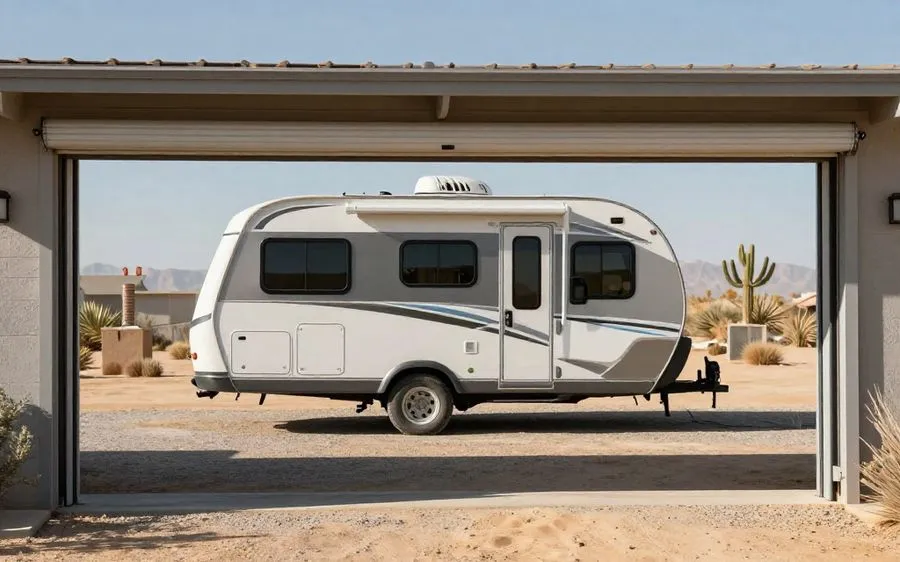
An RV gate starts with the rig, not the wall opening. I have cut two openings wider after the fact for owners who trusted a standard width, and both jobs cost more than getting the tape measure out before the bid. A trailer that clears on a straight approach can still clip a mirror or awning rail when it turns off a Phoenix street into a side yard.
Measure the rig, then the opening
Measure the widest point and the tallest point of the vehicle you will actually move. That means mirrors, awning rails, roof vents, and anything permanently mounted on the trailer or motorhome. Then walk its route from the street. The turn into the drive and the angle at the gate use up room that a simple wall-to-wall measurement hides.
Typical RV gate openings are often about 12-14 ft or wider, but that is a commercial estimate, not a specification. A boat on a trailer and a fifth wheel may need different clear openings even when their bodies look similar from the curb. Height matters too if a roofline, branch, or overhead feature is part of the route.
| What you are moving | Measure this | Clearance to add | Opening that usually results |
|---|---|---|---|
| Travel trailer | Body, mirrors, awning rails, height | Side clearance and room for the street turn | Often about 12-14 ft or wider |
| Fifth wheel | Truck mirrors, trailer width, roof equipment | Side clearance through the turn | Often about 12-14 ft or wider |
| Class A motorhome | Mirrors, body width, roof vents | Side and overhead clearance | Often about 12-14 ft or wider |
| Boat on a trailer | Trailer fenders, boat beam, tow vehicle mirrors | Side clearance and approach room | Often about 12-14 ft or wider |
| Utility trailer | Load width, fenders, tow vehicle mirrors | Side clearance for the turn | Often about 12-14 ft or wider |
Those ranges are typical only. Your measured vehicle and approach decide the opening.
Driveway walk-through
- Measure the vehicle at its widest and tallest points, including mirrors and vents.
- Walk the approach from the street and note where the tow vehicle or rig has to turn.
- Check both sides of the future opening for obstructions.
- Add practical clearance before setting the opening size.
- Only then give the clear opening to bidders.
The ground rules
Metro Phoenix is a wall-first market, so the gate work has to respect the block wall it interrupts. Durable gates begin with structural posts and footings, not attractive infill. Get community approval before city approval where both apply, and call for utility locating at least two full working days before digging under A.R.S. 40-360.21-31.
Is one required where you live?
Do not assume every side yard needs an RV gate, or that any gate size will pass. Some lots and communities require an RV gate opening and set a minimum width, so read the recorded covenants before you order material. Check the city as well, because placement rules can be separate from the HOA’s design standard.
For example, Surprise Municipal Code Sec. 106-10 addresses an RV gate even when it sits with the front of the building. That does not make Surprise’s rule a Phoenix-wide rule. Use the city-specific guidance in the permit process and the community documents for the house in front of you. The wall itself deserves the same early attention as the wall the opening goes into.
How the job runs
First, lock down the clear opening from the vehicle measurements. The contractor then sets heavy structural posts and footings sized for the leaf weight and wind load, builds the surrounding work to the community’s standard, and hangs the leaf or leaves. Depending on wall work and approvals, expect the job to take days to a couple of weeks.
Automation is its own project. If you may add it later, have the posts specified for that future load now; do not simply bolt an operator onto an undersized installation. A powered gate requires monitored entrapment protection, and the automation layer covers that requirement rather than treating it as an accessory.
Why the posts matter more than the leaf
A wide leaf is a long lever. Its post size, embedment depth, and footing volume keep it from dropping as the hardware and frame carry repeated movement. The leaf gets the compliments. The concrete below grade does the work.
Solid infill also catches monsoon wind like a sail. That load reaches the post and footing, which is why the cheapest quote is often cheapest where nobody sees it. I learned this lesson the hard way after a footing call failed in monsoon conditions. I do not promise that any wide gate will never sag, but I do insist that the quote state what is carrying the leaf.
Cutting an opening into an existing wall
An RV gate in an existing block wall is not just a gate installation. It can mean sawing the opening, rebuilding the jambs, and setting posts that carry the new load. That work belongs as separate, readable lines in the bid.
Ask what happens to the block at each side of the cut. If the contractor cannot explain the jamb rebuild, the quote is not ready for comparison. The standard-size sequence is covered in the standard-width version of this job, but an RV opening deserves its own scope.
Reading the quote
Take one written clear-opening dimension to every bidder. A quote that says only “RV gate” leaves too much room for a surprise after the posts are in the ground. Compare the structural scope, not just the leaf style.
| Quote item | What to require in writing |
|---|---|
| Clear opening | Width and height after the gate is installed |
| Leaf | Construction and infill |
| Support | Post size, embedment depth, and footing size |
| Hardware | Hinges, latch, and other listed hardware |
| Wind | How wind considerations affect the structural work |
| Existing wall | Wall cutting and jamb rebuild itemized separately |
| Future automation | Provision for it, if planned |
| Responsibility | Who handles any applicable permit |
Ask two plain questions: “What clear opening does this give my rig?” and “What size are the footings?” A permit may apply and varies by city, so confirm responsibility through the permit process. For the separate width-and-price ladder, use this gate pricing guide.
FAQ
How wide is an RV gate?
An RV gate is commonly about 12-14 ft or wider, but your vehicle plus clearance is what matters. Measure mirrors, rails, and the turning approach before choosing a number. The typical range is not a substitute for that walk-through.
Do I need an RV gate on my lot?
Some communities and some lots require the opening. Check the covenants and the city before you design the wall work, because each can have a separate rule.
Swing or slide at this width?
At this width, geometry and wind push many owners toward a slide. The choice depends on the site, and the gate comparison handles the swing-versus-slide details.
Will a wide gate sag?
A wide gate should not sag when its posts and footings are sized for the leaf and load. Check that structural line in the quote instead of relying on a promise about the finished gate.
What does cutting my wall cost?
Wall cutting is a separate line item, not a detail to assume is included. Ask for the opening cut and jamb rebuild to be itemized with the post work.
Measure the rig, run it through the gate-sizing helper, and take that clear opening to every bidder.
Sources
- Commercial sources on typical RV gate widths, used only as a flagged typical range.
- Surprise Municipal Code Sec. 106-10, RV gate placement rule.
- A.R.S. 40-360.21-31, utility locate obligation.
Last reviewed 2026-07-29.
This article is general planning information, not a site-specific engineering, permitting, or HOA determination. Measure your vehicle, verify current community and city requirements, and have the structural work specified for the gate you are installing.
Read next in projects
Adding Height to an Existing Block Wall
What raising an existing block wall in metro Phoenix really involves: the footing calculation, the permit, how new block ties to old, and where it is not allowed.
New Block Wall Installation in Phoenix
What a new block wall in metro Phoenix involves, what drives its price, the permit and engineering triggers, and what a sound quote must spell out.
Block Wall Repair: Cracks, Lean and Collapse
How to tell a cosmetic crack from a structural one in metro Phoenix, why block walls lean here, the repair options by severity, and what a quote must state.
Want a licensed contractor to call you back?
Leave a number and we pass it to a licensed Arizona contractor. We are not one, we do not bid on the work, and we do not sell your number on.
Request a callback
Send your number to [email protected] with the best time to call and one line about the project. It reaches a person, not an autoresponder, and the page you were reading travels with it so we know what you were pricing.
Advertiser disclosure: this page is free to read because a contractor may pay us for a lead that comes from it. That arrangement never changes what a page says. We publish no contractor names, no rankings and no reviews, and we say plainly when a project is not worth doing.