Walk and Side-Yard Gate
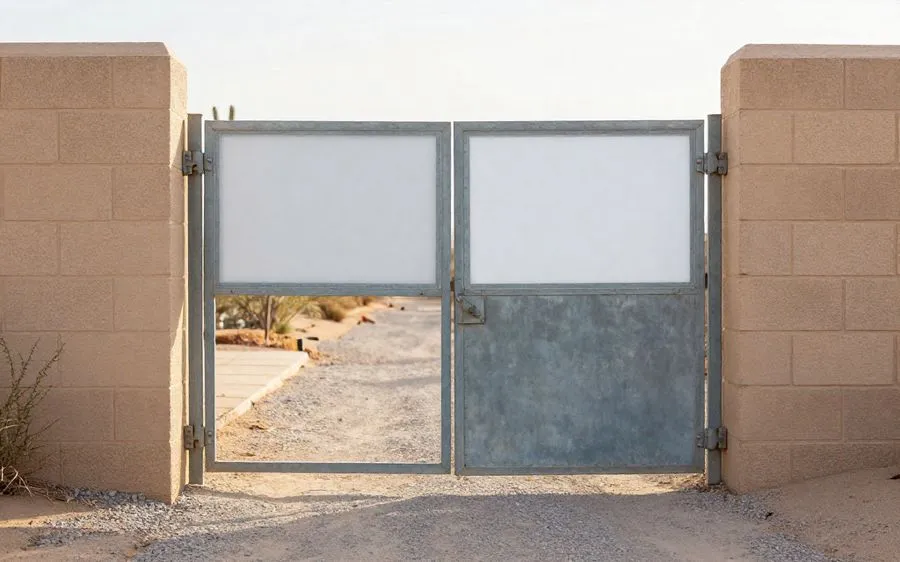
A walk gate is usually the smallest opening in a fence run. That does not make it a throwaway detail. In metro Phoenix, I start with the post, the swing path, and the things that must pass through the opening. Then I ask one question that can change every hardware choice.
A small gate, with one large exception
The enclosure question: Trace the pool’s enclosure with your finger on a plan of your lot. If this gate is on that line, it is barrier hardware.
If the gate forms any part of the pool enclosure, treat it as a pool gate, not a garden gate. Arizona’s pool-barrier rule calls for a self-closing, self-latching gate that opens outward, away from the pool. A plain latch in that location is a safety failure and a code failure, not a cheaper version of the same job. [A.R.S. 36-1681(B)(3)]
The latch requirements are specific. The release must be at least 54 inches above the ground, or the gate needs one of the allowed alternatives: a shielded pool-side release, or a padlock, key, electric, or integral combination device. The sphere test also applies to the gate and its gaps, not just the fence around it. [A.R.S. 36-1681(B)(2)-(3)]
I have watched people focus on a handsome leaf and ignore this question until installation day. Do not do that. If the line encloses the pool, settle the hardware before anyone orders it.
| Element | Ordinary side gate | Gate in a pool enclosure |
|---|---|---|
| Closing | Manual closing is typical | Self-closing required |
| Latching | A daily-use latch | Self-latching required |
| Swing direction | Set by clearance | Opens outward, away from the pool |
| Latch height | Set for convenient use | 54 inches minimum or an allowed alternative |
| Gaps | Fit the leaf and opening | Must meet the barrier sphere test |
For the broader rule, see fence code requirements. For barrier-specific installation planning, read when this gate is barrier hardware.
The ground rules
Phoenix is a wall-first market, so the gate posts decide whether the opening stays true. A small gate alone rarely drives a permit question, but a pool-barrier alteration is a different matter under city codes. Two approvals can still apply if an HOA has its own review process.
If a post hole is part of the job, make the locate call before digging. That is an easy step to skip when the opening looks minor.
Swing, size and hardware
Measure the clear opening, then measure what actually goes through it: the trash bin, mower, wheelbarrow, and your own path with groceries. A gate that only clears a person is not automatically useful. Match the material and frame to the run it sits in; steel is the local default for a side gate.
Choose swing direction from usable clearance. A leaf that opens into a narrow side yard can trap the route you needed it to preserve. Where it is a pool gate, that choice is already made: it opens outward from the pool.
Daily use punishes weak hardware. Specify hinge type and count for the leaf, then specify the latch and its mounting height. Desert heat will not excuse a hinge or latch chosen for a lighter gate. For a bigger opening, the vehicle-sized version is a separate job.
Why small gates sag
Small gates sag because of the hinge and post, nearly every time. The leaf gets blamed because it is what you see dragging, but an undersized post, a shallow setting, or hinges carrying more weight than they were meant to carry puts the opening out of true.
Heat makes that error more obvious. A gate that was barely aligned can bind after the frame and hardware have worked through a hot day. I have seen owners keep adjusting the latch because it gives them something to turn. That treats the symptom.
Ask what is holding the hinge side upright and how the post is set. I would rather correct that answer before a new gate is hung than return to a latch that has been moved twice already.
What moves the price
Width, material, hinge quality, latch quality, and pool-barrier hardware move the quote. Pool hardware is a real cost step when the enclosure question says it applies. It is not an upsell.
Do not compare a basic side gate quote with a barrier-gate quote as if the hardware were interchangeable. For current figures and the choices behind them, see gate prices and automation.
Reading the quote
The quote should describe the gate you expect to receive, not merely say “one walk gate.” Use this checklist before you approve it. A licensed gate or fence contractor is the right starting point; verify the contractor’s classification with the Arizona Registrar of Contractors. [roc.az.gov]
| Bid-spec item | What the quote should say |
|---|---|
| Opening width | The measured clear opening |
| Material and frame | What the leaf and frame are made from |
| Hinge type and count | The hardware and number of hinges |
| Latch type and mounting height | The latch and its installed height |
| Swing direction | Where the leaf opens and the clearance needed |
| Pool-barrier hardware | If any part of the gate is in the pool enclosure |
| Post size and setting | The hinge-post size and how it is set |
Ask the buyer’s question plainly: “Is any part of this gate in the pool enclosure?” It prevents a quote from drifting into assumptions. If the gate is part of a view run, view fence installation covers that different setting.
Frequently asked questions
Does my side gate need to self-close?
Only if it is part of the pool enclosure. When it is, the gate must be self-closing and self-latching under the cited Arizona pool-barrier rule. A standard side-yard latch is not a substitute.
Which way should a gate swing?
Choose by clearance unless it is a pool gate. A pool-enclosure gate opens outward, away from the pool. For an ordinary gate, walk the swing path before approving the hinge side.
Why does my gate drag?
The post and hinges are nearly always the cause. Check for a post that is undersized, shallow-set, or no longer holding the hinge line true before changing the latch. Heat can make a marginal alignment bind.
What material for a side gate?
Steel is the local default. Match the gate to the run it sits in, then make sure the frame, hinges, and post are specified for daily use. Material alone will not keep a poorly supported gate from sagging.
Trace your pool enclosure before you order the hardware.
Sources
- A.R.S. 36-1681(B)(2)-(3), pool gate hardware, latch height, and the sphere test.
- City codes, permit treatment of a small gate and a pool-barrier alteration.
- Arizona Registrar of Contractors, contractor classification guidance at roc.az.gov.
Last reviewed 2026-07-29.
Pool-barrier requirements are safety rules. Confirm the details of your gate and enclosure with the authority having jurisdiction and do not treat this page as a compliance certification.
Reviewed by Alma Reyes, ICC-certified residential building inspector.
Read next in projects
Adding Height to an Existing Block Wall
What raising an existing block wall in metro Phoenix really involves: the footing calculation, the permit, how new block ties to old, and where it is not allowed.
New Block Wall Installation in Phoenix
What a new block wall in metro Phoenix involves, what drives its price, the permit and engineering triggers, and what a sound quote must spell out.
Block Wall Repair: Cracks, Lean and Collapse
How to tell a cosmetic crack from a structural one in metro Phoenix, why block walls lean here, the repair options by severity, and what a quote must state.
Want a licensed contractor to call you back?
Leave a number and we pass it to a licensed Arizona contractor. We are not one, we do not bid on the work, and we do not sell your number on.
Request a callback
Send your number to [email protected] with the best time to call and one line about the project. It reaches a person, not an autoresponder, and the page you were reading travels with it so we know what you were pricing.
Advertiser disclosure: this page is free to read because a contractor may pay us for a lead that comes from it. That arrangement never changes what a page says. We publish no contractor names, no rankings and no reviews, and we say plainly when a project is not worth doing.